Process Audit Frameworks for Operations Leaders
Map your actual workflows before deploying AI to transform them.
Across construction, logistics, manufacturing, and retail, the same mistake keeps repeating: organizations commit to AI-first transformation before they've located where their workflows actually fail. Boards want AI in the operating model. Executives want a transformation story for the next earnings call. So budgets get approved, vendors get selected, and pilots get launched, all before anyone has mapped where the current process actually breaks down.
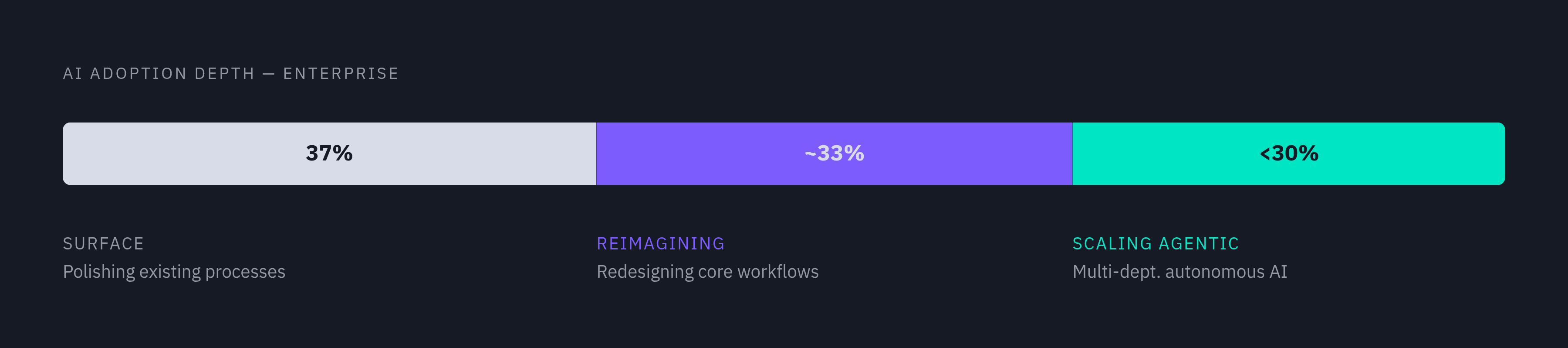
Supply chains in manufacturing and automotive are shifting toward AI-first operations, but scaling that shift requires clean data, standardized processes, and disciplined governance, conditions most enterprises haven't built yet. Organizations that push AI deployment ahead of those foundations get disappointing returns no matter how sophisticated the algorithm is, a lesson drawn directly from transformation attempts that failed. And the scale of the shortfall isn't marginal: more than a third of organizations, 37%, are using AI at a surface level with little or no change to underlying processes, while just over a third are genuinely reimagining how core processes work. The majority are polishing what already exists rather than rebuilding it.
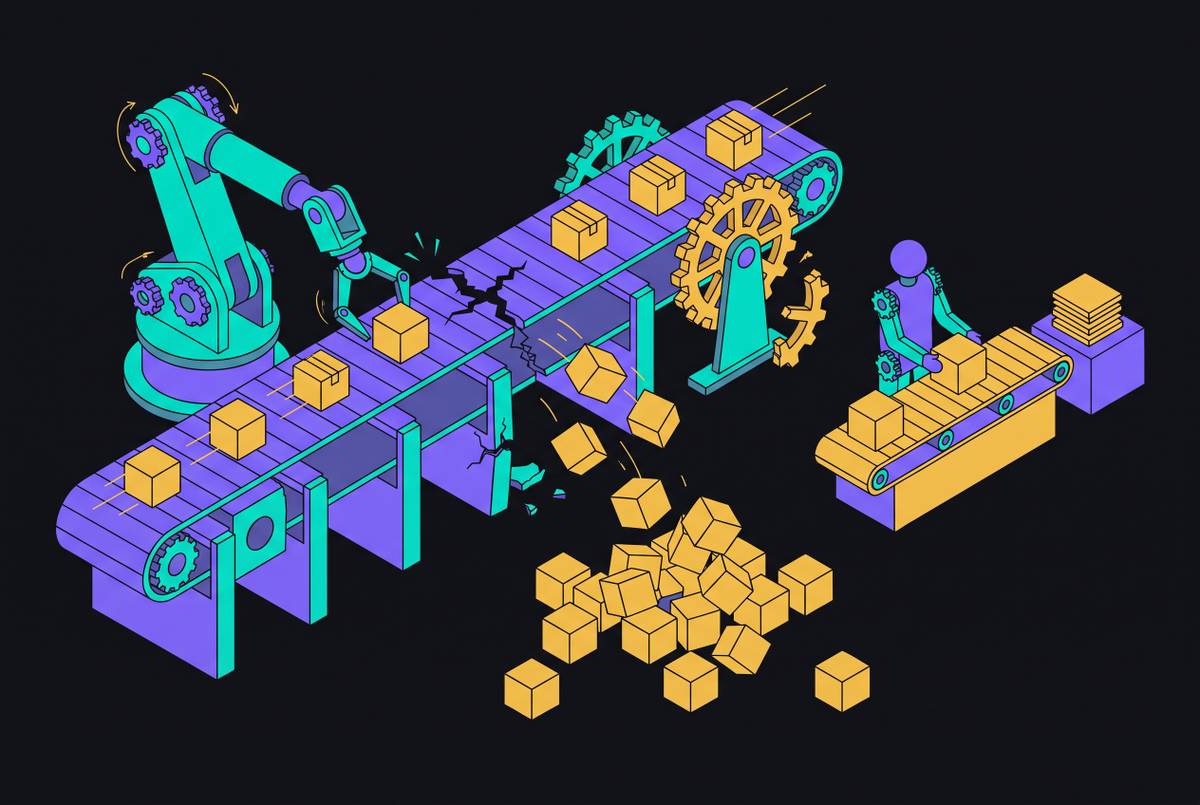
The mechanism behind this failure is mechanical: AI amplifies whatever the underlying process already does. AI doesn't correct a broken process, it amplifies whatever that process already does. Feeding a fragmented procurement workflow into an AI forecasting engine produces a faster, more confident version of the same bad decision. Speed without accuracy just moves the organization toward the wrong answer sooner.
Ask an operations leader why this keeps happening and the answer is usually some version of "we already know where the problems are." That confidence is the problem. Declared problems and real failure points are reliably different things, because org charts and project schedules record intent, not the path the work actually takes once it leaves the planning document. What leadership believes is broken and what is actually breaking are two different maps, and only one of them reflects the floor, the yard, or the warehouse.
What a process audit is
A process audit is a structured method for locating exactly where a workflow breaks down. It is not a documentation exercise, a compliance review, or a warm-up act before software selection.
Documentation records how a process is supposed to run. An audit exposes how the process actually runs, revealing the workarounds staff have built to compensate for missing functionality, the handoffs that fail without triggering any alert, and the decision points where no one holds clear authority and someone improvises anyway. That distinction sits at the center of the entire method.
The output of a real audit is a ranked map of failure points, specific enough to determine what gets rebuilt first. It is not a list of generic improvement opportunities, and it is not a maturity score plotted against some industry benchmark. A gap analysis against a best-practice framework tells you how far you are from an idealized state; a technology readiness assessment tells you what your systems can support; a project scoping exercise tells you what a vendor thinks it can deliver. None of these locate the failure. They're downstream activities that only make sense once the audit findings exist, not substitutes for the audit itself.
The starting point, in every case, is observation of the process as it runs today: who does what, where the work sits idle, where decisions get made informally because the formal system was never built to support them. An organization can't know whether it has standard processes and clean data, the foundation AI integration needs, without first testing them against how the work actually moves. That test is the audit.
Declared plans and org charts hide the real failure points
Project schedules, org charts, process documentation, and risk registers all share one structural property: they're built to record intent. That makes them poor instruments for capturing where execution diverges from the plan, which is precisely where the operational risk lives.
Construction scheduling makes the case cleanly. P6 schedules and similar planning tools capture what was planned, and the real risk sits in procurement lead times, subcontractor coordination gaps, and commissioning readiness, none of which appear on a Gantt chart. Energization readiness, the milestone at which a facility can finally receive power and begin operating, depends on procurement and scheduling converging at the same moment. When that convergence fails, the resulting slip has no single obvious point of failure on the schedule itself, making it a prime target for an auditor rather than a scheduler.
Risk management follows a similar pattern in project delivery more broadly. It's strongest at the proposal stage, when the business case is being built and scrutinized, and it thins steadily as execution proceeds, according to the Deltek Clarity Government Contracting Industry Study 2026. The phase most exposed to real operational risk turns out to be the phase least monitored for it. That's not an accident of any one company's discipline. The people who write risk registers work at a different point in the project lifecycle than the people managing the actual execution risk, and the two groups rarely compare notes with the frequency the stakes would justify.
Cascading risk compounds the problem further. Cyber risk, third-party risk, fraud risk, data risk, and legal risk now interact and amplify one another, so a single operational failure can trigger regulatory exposure, legal action, and reputational damage in the same event. A process audit that examines only one risk category at a time will miss exactly this kind of interaction, which is often where the real cost concentrates.
Heavy equipment maintenance in construction supplies a concrete, measurable version of the same structural blind spot. The average heavy equipment fleet lost 14% of its annual operating hours to unplanned breakdowns in 2025, even where maintenance schedules existed on paper. The schedule wasn't missing, but the audit still has to observe failure patterns as they happen, in real time, rather than reconstruct them after the fact from a breakdown log.
The specific failure modes a process audit is designed to find
An audit isn't a search for problems in general. It targets a specific, recurring set of structural failure modes that appear across asset-heavy, process-intensive operations, and knowing what these look like in advance shapes how the audit gets conducted.
Fragmented data that masquerades as visibility is the first and most common. AI models can only improve forecast accuracy where clean data pipelines already exist, so an audit has to test whether the data an organization believes it has is actually clean, consistent, and reachable across the systems that are supposed to share it, rather than accepting the claim at face value.
Handoffs that fail silently are the second. Work moves between functions, systems, or suppliers constantly, and wherever that handoff lacks a clear owner or a confirmation step, delays accumulate without tripping any alarm. Nobody notices until the delay has already compounded into a missed deadline.
Informal workarounds that have quietly become load-bearing form the third failure mode. The spreadsheet a planner keeps because the ERP can't run a critical calculation, the phone call that happens because the system of record doesn't reflect current supplier lead times: these solve a real problem day to day, but they turn into invisible risk the moment the person who built the workaround leaves the company.
Front-loaded risk management that disappears during execution is the fourth. Risk registers get completed carefully at the proposal stage and then sit untouched, a documented pattern in both government contracting and construction, where execution is simultaneously the most exposed phase and the least monitored.
AI and tool sprawl make up the fifth failure mode, and it's a newer one. A large share of enterprises now report that AI sprawl is raising security risk and adding operational complexity, because agents get built independently across different teams and frameworks, and the resulting fragmentation is itself an operational failure, not a symptom of one.
Model risk introduced by ungoverned AI deployment rounds out the sixth. Bias, drift, hallucination, and unintended automated decisions all need a place in the operational risk taxonomy, because deploying AI agents into mission-critical workflows without explicit model-risk governance turns a technical risk into an operational one almost instantly.
What a resolved version of these failure modes looks like is visible in logistics. Kuehne+Nagel's tiered confidence scoring in customs classification routes high-confidence cases to automatic processing, sends mid-confidence cases to expedited human review, and escalates low-confidence cases to specialist brokers. That kind of design only becomes possible once an audit has identified where classification errors actually concentrate and why, rather than treating every customs decision as equally uncertain.
How to conduct the audit
The audit follows a fixed sequence, and the order matters as much as the content. Observe the process as it runs today before asking why it runs that way, and locate the point of pain before deciding what to fix.
Start by having the process shown, not described. The people who run the process need to walk through it in real time, or walk through a recent real example, rather than summarize it from memory. The gap between that walk-through and the official documentation is itself a finding, often the first useful one an audit turns up.
Trace the work, not the org chart. Follow a single unit of work, a purchase order, a maintenance ticket, a shipment, a schedule update, from the moment it's triggered to the moment it's completed, and mark every point where it waits, gets rerouted, or needs an action the system doesn't actually support. Tracing the work this way turns the audit from a theoretical exercise into a map with real coordinates on it.
Locate where the pain concentrates before chasing root causes. Ask where the work is hardest, where errors cluster, and where people are forced to make decisions nobody should be asking them to make on the fly, since that is what surfaces the failure point. Root cause analysis comes afterward, once the location is confirmed.
Baseline what the process actually costs and how long it actually takes right now, because measurement frameworks need to track direct cost reductions, gains in operational speed, and strategic capability improvements, and none of that can be measured against a real number unless the audit captures the current state honestly rather than the number the system claims it should be producing.
Check the data the process depends on. Standard processes and clean data are supposed to be foundational for AI integration, so the audit has to test that claim directly rather than assume it holds. Map the informal layer as its own step, cataloguing the workarounds, the personal knowledge, and the off-system steps that are quietly keeping the process alive, because that layer is both a source of hidden risk and the design input for whatever eventually replaces the process.
Rank what's been found using two criteria only: how often the failure hits, and how severe the consequences get when it cascades into other parts of the operation. Not every failure point deserves a rebuild. The ones sitting at the intersection of multiple downstream dependencies do.
Keep technology selection, vendor evaluation, and AI model choice entirely out of scope during this phase. Those decisions follow from what the audit finds, and introducing them early contaminates the measurement itself, because teams start shaping their observations around a solution they've already half-committed to. The audit should also check governance capacity: only one in five companies, 20%, has a mature model for governing autonomous AI agents, and it should confirm that governance infrastructure exists before anyone recommends deploying an agent into the rebuilt process.
How to prioritize what to rebuild first
The audit hands leadership a ranked map of failure points. The decision that follows, which one to rebuild first, has a correct answer that the audit data actually supports, rather than one leadership has to guess at.
Pick the process where the failure hits most often, where the downstream consequences are clearest, and where the data and operational conditions already exist to support a rebuilt version. Don't pick the largest process or the most visible one. The production gap in enterprise AI backs this up starkly: only a small fraction of organizations are successfully scaling agentic AI across multiple departments, even while most are still experimenting, which suggests that starting with a bounded, genuinely painful process reaches production far more reliably than launching a broad transformation program all at once.
A process picked without integration-ready data will stall in exactly the same place the failed pilots did, since the vast majority of generative AI pilots stall because of flawed enterprise integration rather than weak underlying models.
Manufacturing shows this gap in sharp relief. Nearly all manufacturers now use some form of AI, yet only a minority of manufacturing digital transformations achieve real operating-model impact, BCG research found. That gap between declared adoption and genuine transformation is the story. A process audit closes it by making sure the first rebuild changes how the operating model actually works, rather than layering another tool on top of a process nobody fixed.
Leaders often push back with "we should start with the highest-value process." Resist that instinct. The highest-value process is rarely the fastest to rebuild, and it usually carries the messiest data of any candidate on the list. A clean, successful rebuild of a smaller process builds the organizational muscle and the internal trust needed to take on the harder ones later.
A wrong first choice has a recognizable shape: the process with the most executive visibility, the largest projected ROI in a slide deck, or the most polished vendor pitch. Those criteria predict what gets approved in a steering committee, not what actually gets built and used. Organizations that set measurement frameworks before deployment can show value throughout implementation instead of hoping ROI shows up after the technology's already been rolled out, and the audit is exactly where those baselines get set.
The audit is the first act of transformation, not a preliminary step that happens before it begins.
What becomes possible once failure points are known
Organizations that locate their real failure points before committing to a rebuild are the ones that reach production, not the ones that stall out at pilot. The number of companies with a substantial share of AI projects in production is set to double within six months, and that growth concentrates in organizations that have done the foundational work an audit surfaces: clean data, standardized processes, governance infrastructure already in place.
Microsoft's supply chain organization is scaling past 100 operational agents by the end of 2026, after reporting hundreds of hours saved each month, because the operational design came first and the agent deployment followed. Predictive maintenance follows the same logic: it becomes genuinely actionable once condition monitoring, failure prediction models, and maintenance scheduling get rebuilt as integrated functions, not when sensors get bolted onto a maintenance process nobody has touched. An audit reveals whether those functions are actually integrated, or just sitting next to each other in separate silos.
Capability like that reaches production grade because the underlying scheduling and procurement data is clean enough to act on directly, which is the condition an audit exists to confirm before anyone builds on top of it.
Governance is the last piece, and it's the one most likely to get skipped under deadline pressure. Agentic AI usage is set to rise sharply, but oversight is lagging behind it: only one in five companies has a mature governance model for autonomous agents. The process audit is the mechanism that establishes what governance an organization actually needs before agents get deployed into live workflows, not after those agents have already created the failures governance was supposed to prevent. Knowing what's broken before deciding how to fix it is the only reliable route from a declared intent to a process that actually runs differently.