Handoff Failure Detection in Multi-Department Workflows
Departments hit their targets while seams between them fail invisibly.
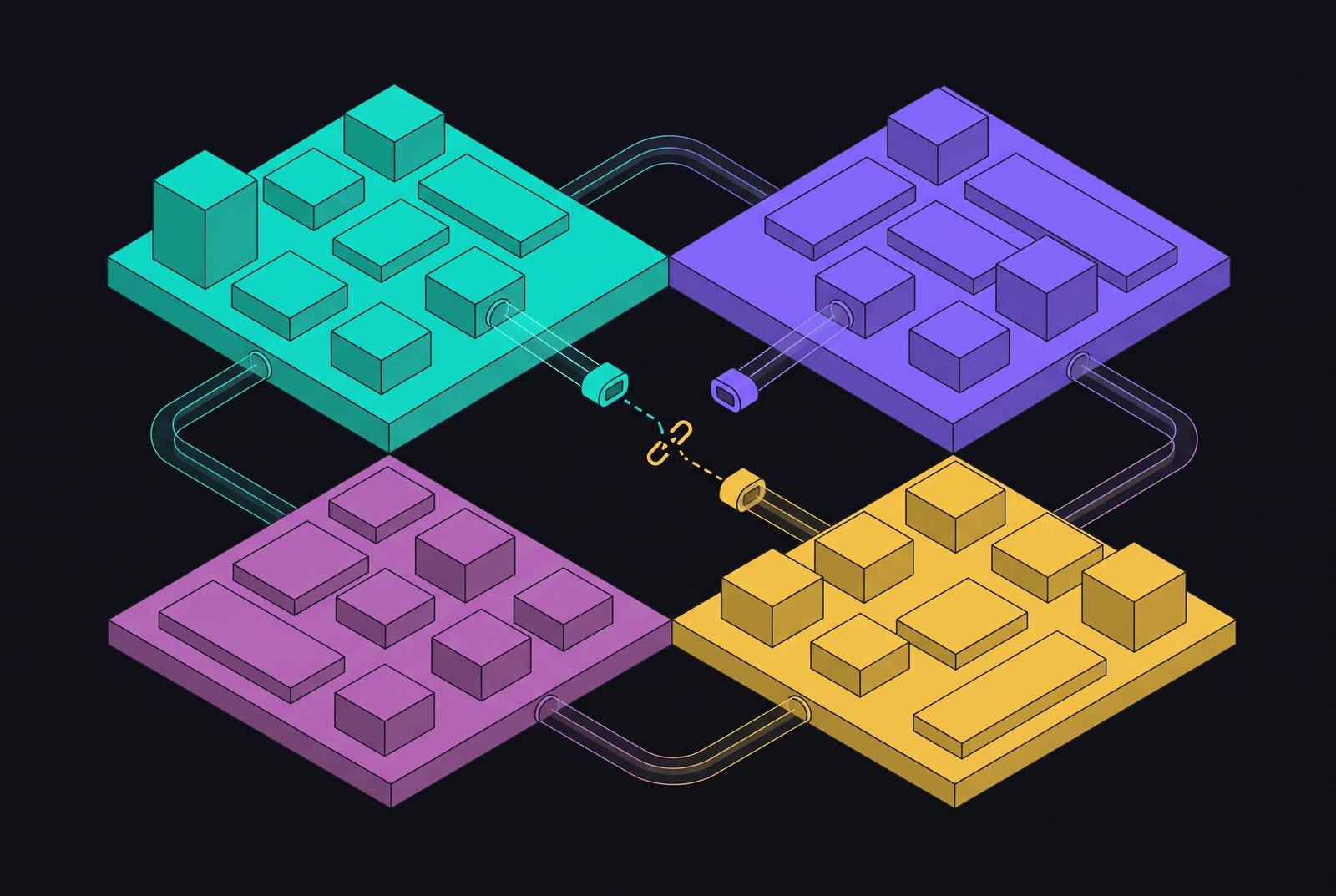
A regional distribution company documented by ECLSM Advisors had warehouse metrics that beat industry benchmarks on every measure that mattered inside the building: pick accuracy above benchmark, inventory shrinkage minimal. Customer satisfaction was falling anyway, and the pattern holds across industries: handoff failure is a design failure, structurally guaranteed to concentrate at the boundary between departments rather than inside any one of them. When the audit traced the complaint pattern back to its source, it found the failure living in the transition between the warehouse management system and the customer-facing order management platform, in a manual step that the process required but that no one in particular owned. The warehouse itself never failed. The seam between the warehouse and the order platform failed, and it had failed invisibly, because it belonged to neither system's dashboard and neither team's job description.
Inside a department, coordination happens informally and that informality covers for weak process design. None of that machinery exists at a boundary. The moment work crosses from one department to another, the shared manager disappears, the shared tool becomes two incompatible tools, and the shared goal splits into two goals that were never reconciled. Every safety net that absorbed bad process design inside the department vanishes at exactly the point where the work has to survive without one.
The math behind this is unforgiving even in its simplest form. Picture a process that runs through six handoffs, each individually reliable on its own terms. That is a statement about what happens when reliability gets multiplied across a sequence of boundaries, not about any one team's competence: the failure probability of the whole accumulates almost entirely between the boxes on the org chart, not within them. This is why long cross-functional processes feel chaotic even when every department involved is hitting its own targets. The seam is the problem. The departments are not.
How metrics make an unowned seam worse
Departmental KPIs are built to measure performance inside a box, and that design choice has a side effect nobody intends but everybody lives with: it makes boundary failure someone else's problem by construction. There is no scorecard for the seam. Each team optimizes the throughput it is held accountable for, and no one is paid to optimize the handoff that connects them.
The measurement gap is the logical output of how departments get evaluated in the first place, and attribution becomes contested as soon as something goes wrong at the boundary. ECLSM Advisors describe exactly this dynamic in a freight-claims dispute. The finance director believes logistics is submitting incomplete documentation. Both are partially correct, and neither owns the solution, because the solution does not live inside either department's remit.
Much of this traces back to handoff protocols that were never designed. Tier2 Systems make the structural point directly: no single person drops the ball in these situations, the process does. The deficiency is not attitudinal, it is structural, and telling two teams to talk more does nothing to change who is accountable for the step between them.
A manufacturing case from ECLSM Advisors shows what this looks like when the savings are real and still disappear. If measurement never reaches the seam, no one inside either department is going to spontaneously take responsibility for fixing it, because fixing it does not appear on anyone's performance review. That is the condition any serious detection effort has to start from.
The five failure modes that recur at every boundary
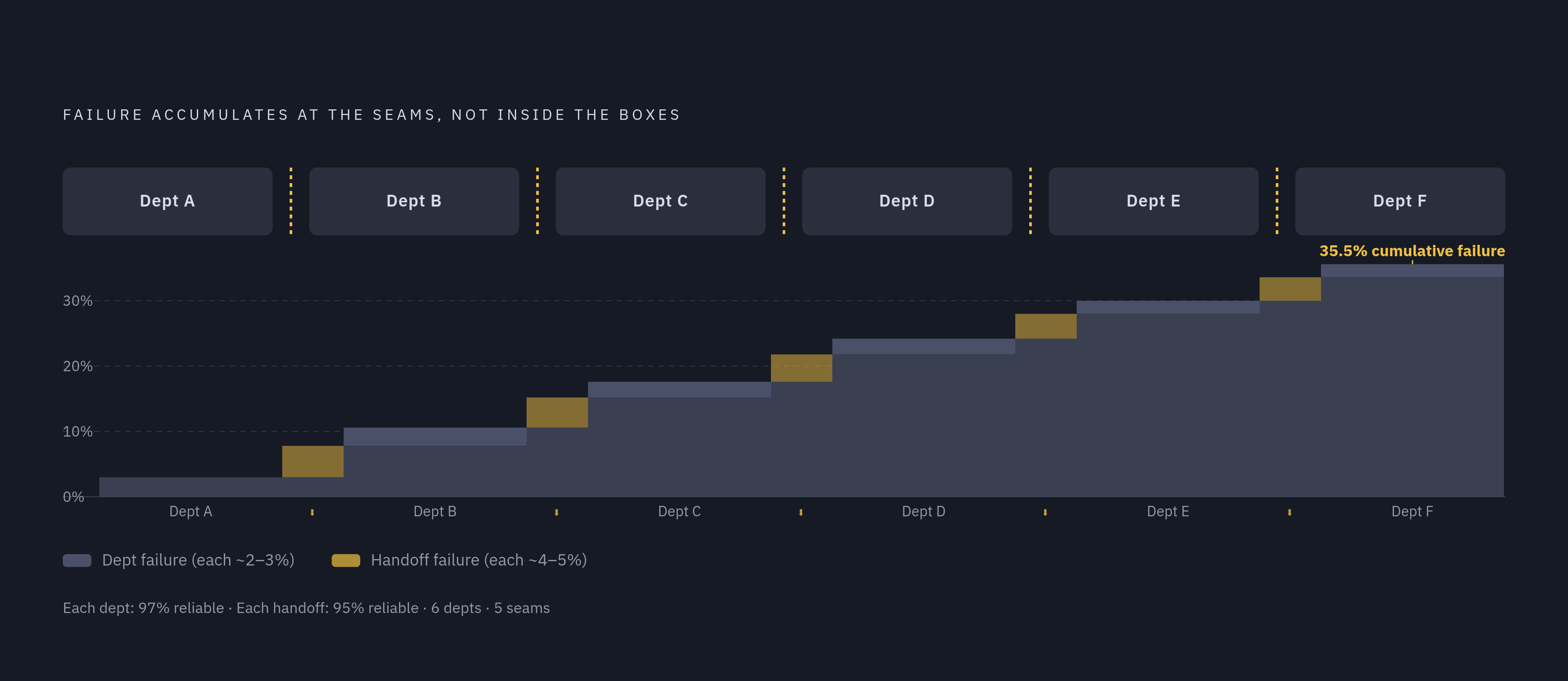
Handoff failures are not infinite in variety. Most of them collapse into five recognizable structural patterns, and a boundary in real trouble is usually suffering from two or three of them layered on top of each other.
The first is the email handoff that strips context on the way through. The work item travels as prose written from the sender's point of view, the thread is invisible to anyone who was not copied, and the result is a receiving team with no visibility into history and a sending team with no visibility into progress. Tier2 Systems describe this exact pattern in sales-to-operations handoffs, where sales captures specifications in one format and operations reads them in another, and the gap between the two formats is where the error gets made.
The second is the missing acknowledgment loop. Superkind describe the most dangerous state a handoff can sit in as "sent but not accepted": the sender believes the work is moving because the sender sent it, while the item itself sits unread in someone else's queue. A handoff without a mandatory acknowledgment step is a hope, not a process, and when the failure eventually occurs, it tends to appear as a customer escalation rather than a routine internal alert, because nothing in the system was built to flag it earlier. Tier2 Systems identify where this concentrates most often: sales to operations, where custom requirements sit in free-text emails, verbal commitments go undocumented, and delivery timelines get agreed without anyone checking capacity; operations to finance, where completed work sits in a queue because nobody triggered the billing step and time entries don't match the original quote; procurement to warehouse or delivery, where purchase orders go out without delivery dates or handling instructions and receiving teams never get notified that a shipment is coming; and customer service to operations, where tickets arrive with insufficient detail and priority levels that don't match what operations can actually absorb.
The third is the misaligned service-level agreement. What the sending team treats as urgent, the receiving team treats as routine intake, and without an agreed SLA between the two teams, prioritization defaults to whoever escalates the loudest. That default teaches the entire organization to escalate everything, because escalation becomes the only mechanism that reliably gets a response.
The fourth is swivel-chair data re-keying, the manual retyping of information from one system into another because the two were never integrated. ECLSM Advisors document a professional services firm losing billable hours this way, because the transition between project delivery and billing lacks any defined trigger and any single responsible owner, so the information sits until someone happens to notice it needs to move.
The fifth, and the cause running through several of the others, is the absence of a defined deliverable at the transition point itself: no shared understanding of what "done" means on the sending side and what "accepted" means on the receiving side. A practitioner who can name which of these five modes dominates a given boundary has already done most of the diagnostic work. The rest is confirming it.
Why the seam is harder to see in construction, logistics, and manufacturing
In construction, logistics, and manufacturing, a broken handoff does not just slow a task down. It breaks a dependency chain, and recovering a broken dependency chain costs disproportionately more than the original handoff would have cost to get right.
Construction makes the sequencing version of this problem unusually visible once it starts to unravel. Schedule delays almost never come from a single isolated event. They build when labor, approvals, material deliveries, inspections, and utility energization interact without enough float or a credible way to recover once something slips. Energization is a particularly diagnostic case: a slip on a gas-line tie-in where the final inspection depends on utility service can cascade through the pressure test, the equipment startup, the appliance checks, and the occupancy sequence, moving all of them even though the original delay was small. A utility's March 31, 2026 Biannual Energization Report, filed with a state utilities regulator on April 1, 2026, states the institutional version of this problem without euphemism: the utility recognized that energization is a multi-stage process involving multiple handoffs, systems, and stakeholders, requiring improved coordination, transparency, and accountability. The same filing documents a field-evidence problem behind the schedule slippage: a customer may enter a placeholder energization date in an effort to submit a request, or a date that is entirely infeasible, and the originally submitted Customer Desired Energization date is often revised later. A utility with every incentive to coordinate well still found itself formally acknowledging, in a regulatory filing, that its own handoffs needed redesigning.
Procurement timing has become its own independent handoff crisis in construction, separate from energization but compounding it. Power transformer lead times now exceed two years, which forces projects to commit to procurement based on pre-design specifications rather than waiting for a finished design. Programs that wait for completed design before initiating procurement find that the equipment queue has moved out by 18 to 24 months in the meantime. Leading EPC firms have responded by locking in manufacturing slots as a first-phase activity, before design is complete, because the alternative is losing a year and a half to a queue that never stops moving.
Logistics carries a structurally similar problem in a different shape: the gap between the declared plan and field reality. The handoff failure in this environment typically stays invisible until a customer escalation forces it into view, because nothing in the fragmented documentation was built to surface it earlier.
Manufacturing follows the same pattern already visible in the ECLSM Advisors procurement case: gains made inside one department get neutralized at the boundary to the next because no handoff protocol exists to carry them across. Across all three industries, the real cost of a broken seam is never the direct labor of the original error. It is what that error triggers downstream. Tier2 Systems describe the resulting cascade: late deliveries, billing disputes, customer complaints, and the slow erosion of trust between teams that end up blaming each other for a failure that belonged to neither.
What a seam audit examines, and what internal performance reviews miss
Detecting handoff failure requires treating the interface between departments as the unit of analysis, and the standard performance review is structurally unable to do that, because it looks inside each department rather than between them. ECLSM Advisors frame the core diagnostic challenge directly: when a process breaks within a department, the failure is relatively visible to the people managing that department. When it occurs at the boundary, attribution becomes contested and the investigation stalls before it reaches a cause. Making the invisible visible is the first task of any audit worth the name.
The goal at this stage is a complete inventory of transition points, regardless of how well or badly each one is currently managed.
The second step is harder and more revealing. If the answer is unclear, or if accountability is shared between two departments without a designated lead, that is a structural gap, not a personnel problem. Every handoff needs a single accountable owner, and that owner has to be an individual, not a department, because a department cannot be held to a deadline the way a person can.
The third step is to define the specific deliverable at each transition point. Practitioners can apply a simpler heuristic before committing to any larger automation project: run a two-week workflow audit first, and identify the three decisions or tasks that currently take the longest, produce the most rework, or get handed off the most times. Those three are the strongest candidates for redesign, because they are where the structural gaps are already visible in the data the organization already has.
Construction requires one further layer that office processes don't. P6 schedules and similar planning tools record intent, not achievability, and an audit that stops at the Gantt chart will miss where the real risk lives. A schedule that does not reflect how procurement actually releases material, how crews actually mobilize, or how inspections actually sequence in a given jurisdiction will look clean on paper and fail under pressure. Finding it requires going to look at the seam directly.
Detecting seam failures even when looking for them
Even an organization that knows to examine the boundary runs into a second layer of difficulty: the evidence of a failed handoff usually appears in the department downstream of the failure, not at the point where the failure happened. Superkind describe the pattern across three distinct scenarios. None of these are failures of skill on the part of the people involved. They are failures of the seam connecting one team to the next, and the investigation that follows one of these incidents naturally starts in the department where the damage occurred, which is rarely the department where the damage originated.
The gap between the declared plan and field reality compounds the detection problem in construction and logistics specifically. A plan states that a handoff occurred on a given date, while field reality may be that a placeholder date was entered to satisfy a form, the handoff was only partially complete, or the receiving party never actually confirmed acceptance. The SDG&E filing documents exactly this condition, with customers entering infeasible energization dates and the utility having to engage directly with those customers to establish timelines that are actually achievable.
The "sent but not accepted" state described earlier is dangerous precisely because standard reporting cannot see it. The gap between those two records is exactly where the failure lives, and it is a gap that no dashboard is built to point to, because dashboards are built from the records systems keep, and neither system kept a record of the space between them. By the time a seam failure becomes visible, the organization is usually looking at its consequence in a department that did nothing wrong, while the actual point of failure sits one step upstream, unrecorded and unowned.