Shadow Work Identification in Logistics Operations
Hidden labor keeps logistics running while official processes fail silently.
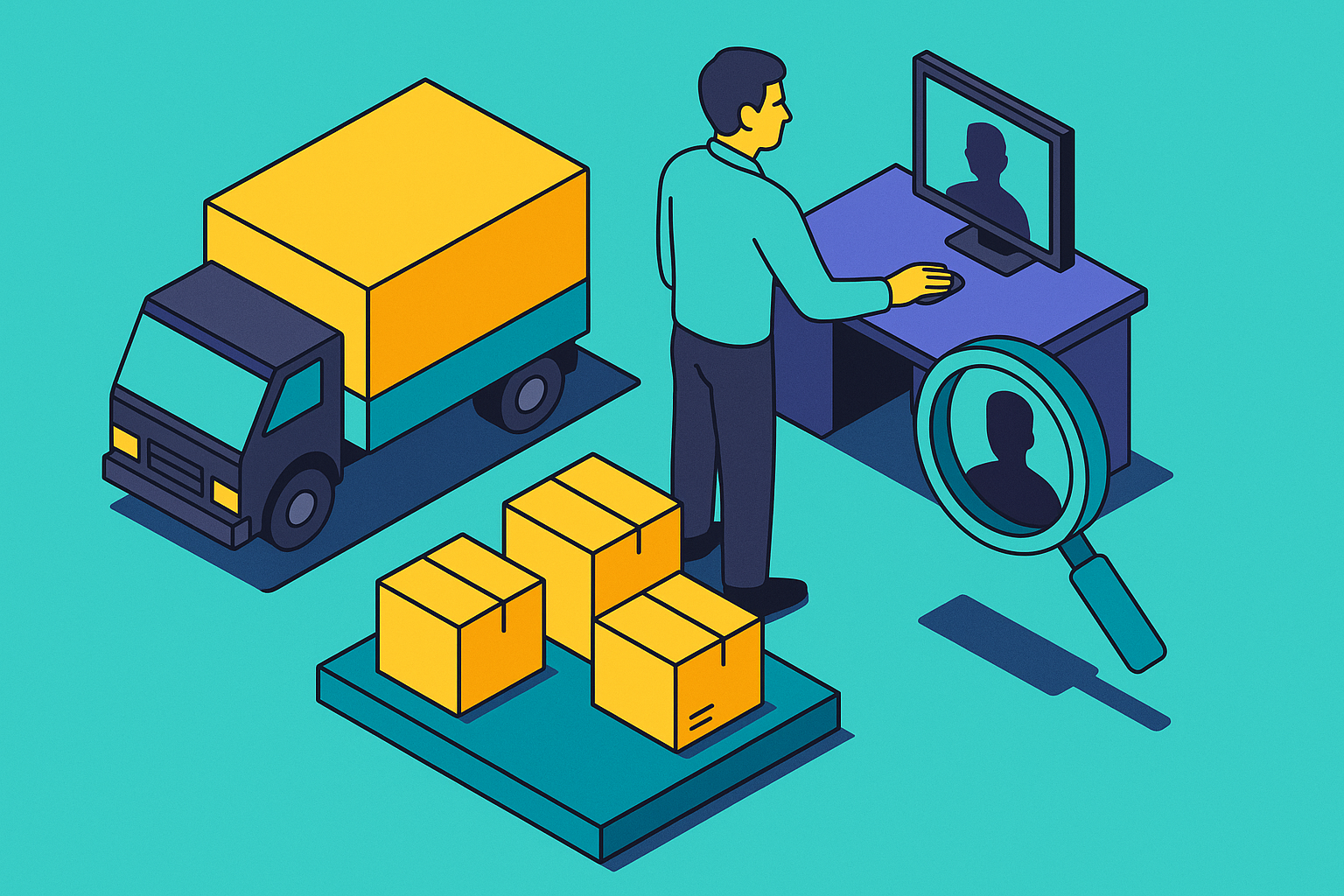
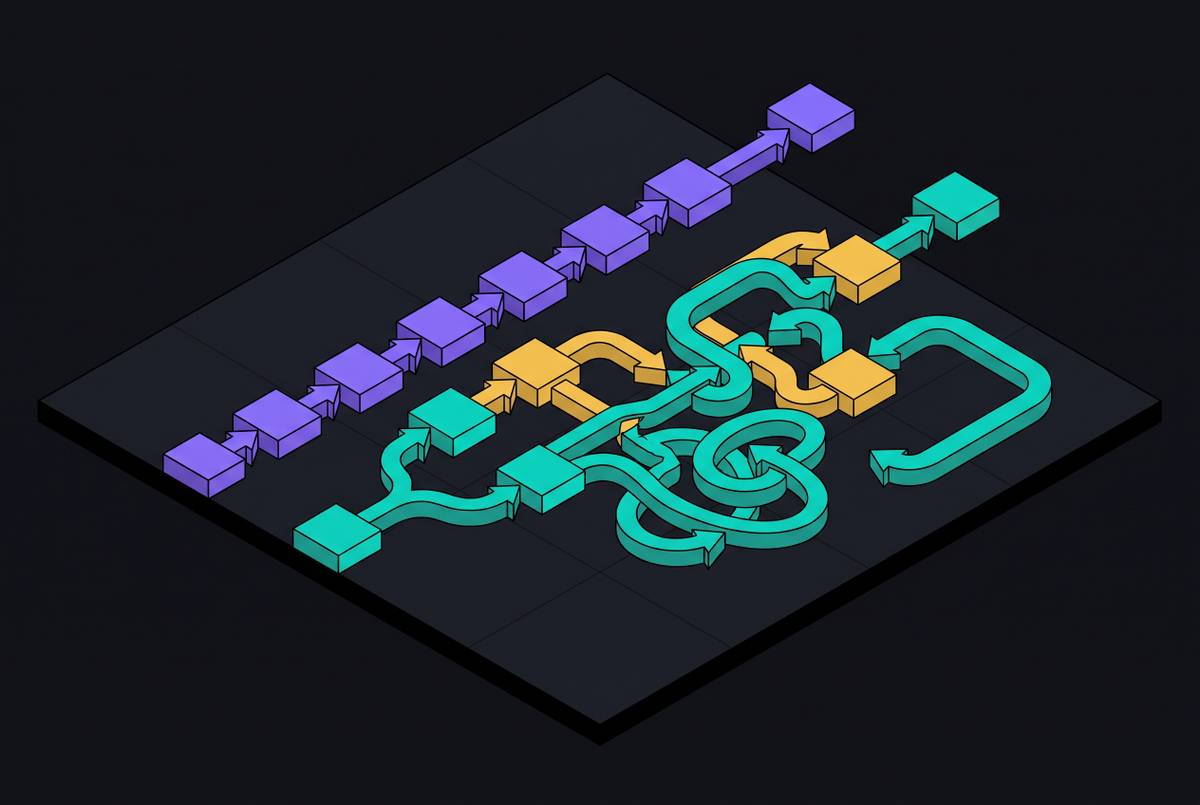
Shadow work in a logistics operation has nothing to do with psychology. It is the accumulated layer of unrecorded labor, informal approvals, and manual reconciliation that keeps freight moving even when the official process has quietly stopped working. It takes three overlapping forms: manual workarounds that substitute for automation that failed somewhere upstream; informal approval rerouting and data reconciliation that never makes it into the official record; and unsanctioned tools that employees reach for on their own when the sanctioned workflow cannot keep pace with the work in front of them. The root cause sits in a simple mismatch: the declared process, the one written down and reviewed in meetings, diverges from the lived process, the one that field personnel actually run to get the job done. Everything that follows in this piece depends on holding that distinction clearly: what the system log says happened, and what actually happened on the floor, in the truck, or in an email chain nobody archived.
Why shadow work is structurally invisible to the people running the operation
Shadow work doesn't persist because operations leaders are careless or inattentive. It persists because it occupies the space between what process documentation says should happen and what people actually do to keep freight moving, and that space does not appear on any dashboard built to track the declared process. Process audits expose this gap constantly: the system log shows a task assigned and closed on schedule, but the actual work happened in a forwarded email chain, a Slack thread, or a verbal handoff between two people that left no trace anywhere. Regulated manufacturing operations show the mechanism directly. Nothing failed on paper. The process worked exactly as documented on the floor and failed exactly where nobody was looking, on the record.
Procurement shows the same pattern from a different angle. The system still shows the task assigned and pending. It never actually arrives anywhere a human being will act on it.
Carrier scorecards offer the clearest diagnostic signal available to an operations leader looking for this gap. When every carrier on a scorecard shows strong on-time delivery performance while customers keep calling about late freight, the carriers are not lying and the scorecard is not useless. The data pipeline feeding the scorecard is broken. Somewhere between the event that triggers an on-time mark and the outcome a customer actually experiences, there's a recording step that shadow work has quietly replaced. That gap, between what the scorecard says and what the complaint log says, is exactly where shadow work lives, and it is often the single most legible signal an operations leader has without running a formal audit. High turnover in last-mile delivery networks makes the problem worse over time: the workers who learned the workarounds and could explain them leave before any of it gets written down, and the next person has to relearn it from scratch.
How the rise of AI tools in logistics is creating a new, faster-moving layer of shadow work
AI adoption hasn't slowed this problem down or replaced it. It has added a new category of shadow work that moves faster and reaches deeper into operational systems than manual workarounds ever did. IBM's Cost of a Data Breach research found that one in five organizations reported a breach linked to shadow AI, and only a minority of those organizations had any policy in place to manage or even detect it.
What makes this different from older forms of shadow IT isn't just scale. Autonomous agents don't simply store or move data the way an unsanctioned spreadsheet or file-sharing app does. In a logistics workflow, an agent wired into a transportation management system or a procurement platform with a high-privilege API key is a non-deterministic entity capable of modifying operational state on its own, invisibly, at machine speed.
Most organizations, when asked directly where their agents are deployed and what those agents are permitted to access, cannot give a clear answer. That visibility gap isn't a hypothetical risk sitting somewhere in the future. The standard playbook for managing shadow IT, built around discovering unsanctioned SaaS logins and flagging unmanaged devices, is relevant here but not sufficient on its own. Security tools built to catch shadow IT are largely blind to agentic, ephemeral identities that spin up, act, and disappear. Standard data loss prevention and identity access management tools don't see the unvetted logic calling third-party resources through hardcoded API keys, because that logic was never built the way the tools expect unsanctioned activity to look.
What breaks when shadow work goes unidentified
Unidentified shadow work doesn't sit quietly in the background indefinitely. It compounds, and the pressure of a high-stakes moment typically forces it into view, usually at the worst possible time.
Procurement offers a precise illustration. The supplier delivers what was asked for on the PO and never agreed to the retention requirements the customer required, because that requirement never made it past the contract review stage into anything the supplier could see. The gap stays invisible until an audit finds it, and by then the exposure has already existed for the length of the contract.
The clearest public example of this pattern at scale comes from a September 2025 field audit by a federal oversight body, documented in a public report, and none of what it found reflected a written plan that failed on paper. The declared plan was compliant. The field evidence told a different story, and the distance between the two was shadow work that nobody had gone looking for until the audit forced the issue.
Mission-critical project delivery runs into a related failure. Status updates happen verbally, workarounds get built on the fly, and none of it reaches the master schedule that a scheduling tool is supposed to be managing. An AI-driven scheduling tool layered on top of that situation models the declared plan, which is a different thing entirely from what's happening in the field, and the tool has no way to know the difference. Those gaps are absent from policy documents. They appear in audits, in incidents, or in regulatory reviews, which is to say they become visible after the cost has already been incurred.
Why automating before identifying shadow work makes the problem worse
Automating an operation before its shadow work has been identified doesn't remove the underlying dysfunction. It speeds the dysfunction up and makes it considerably harder to reverse once it's embedded in a new system.
Duplicate approvals stay duplicate approvals once they're automated, they just happen faster. Unnecessary handoffs stay unnecessary handoffs. Redundant data entry still happens, now executed by machines at machine speed. The inefficiency survives the automation project intact, and the pace at which it can cause downstream failure increases.
A Stanford study examining 51 successful enterprise AI deployments confirmed this pattern directly. The deployments that failed had been treated as technology projects rather than as process and change management projects, and the first attempts consistently failed when the AI was applied directly to a workflow that was already broken underneath. The technology performed as designed. The process it was asked to run on top of had never been fixed, and the automation simply ran the same broken process faster and with less human judgment available to catch the failures that used to get caught informally, by the person doing the workaround.
This is the argumentative core of the whole problem. Identification is not a preliminary step that operations leaders can skip in the interest of moving faster toward a deployment deadline: it determines whether an automation project lands on the real process or on a declared version of a process that no longer reflects how the work actually gets done.
How to identify shadow work in a logistics operation before touching a process
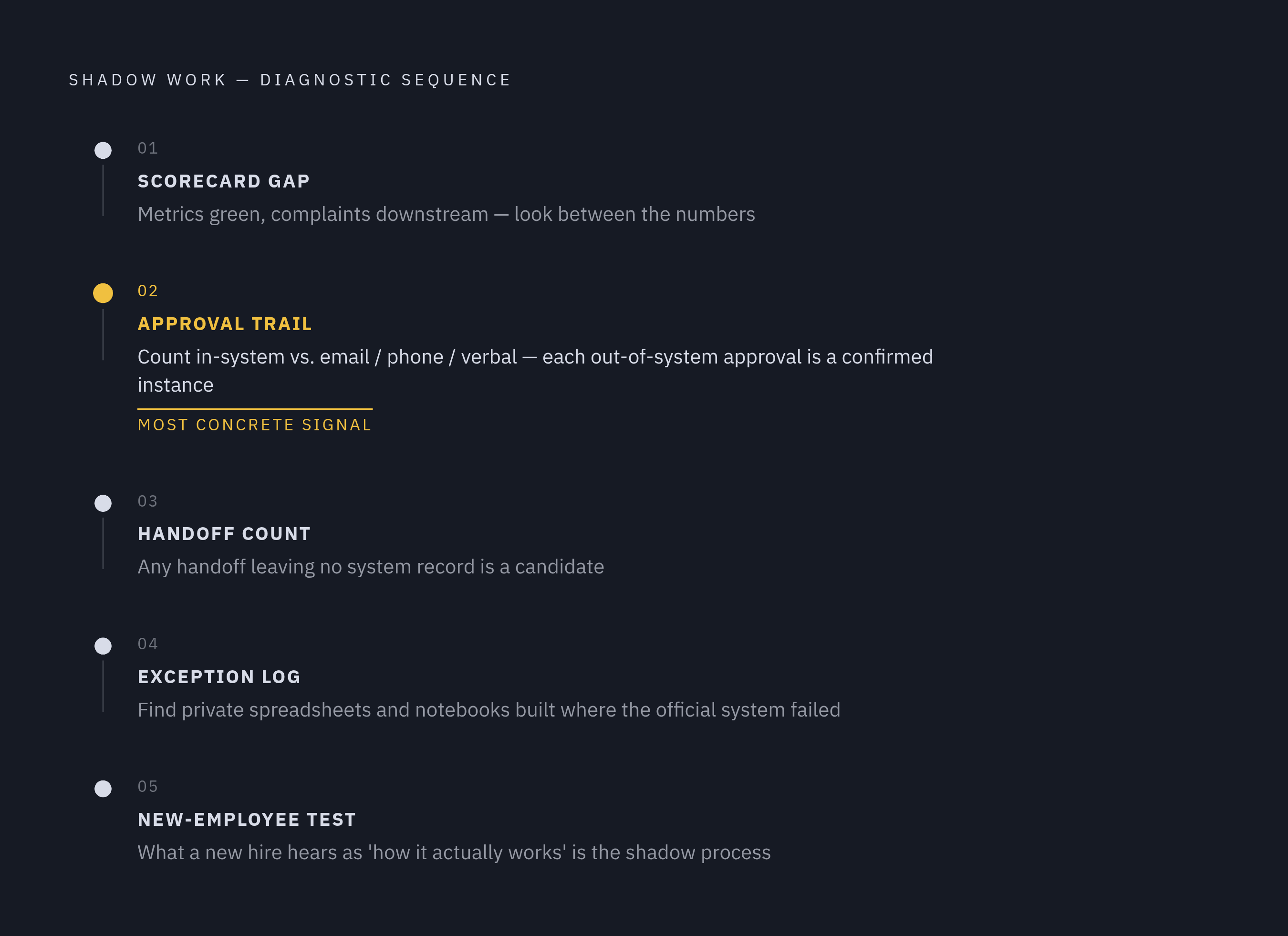
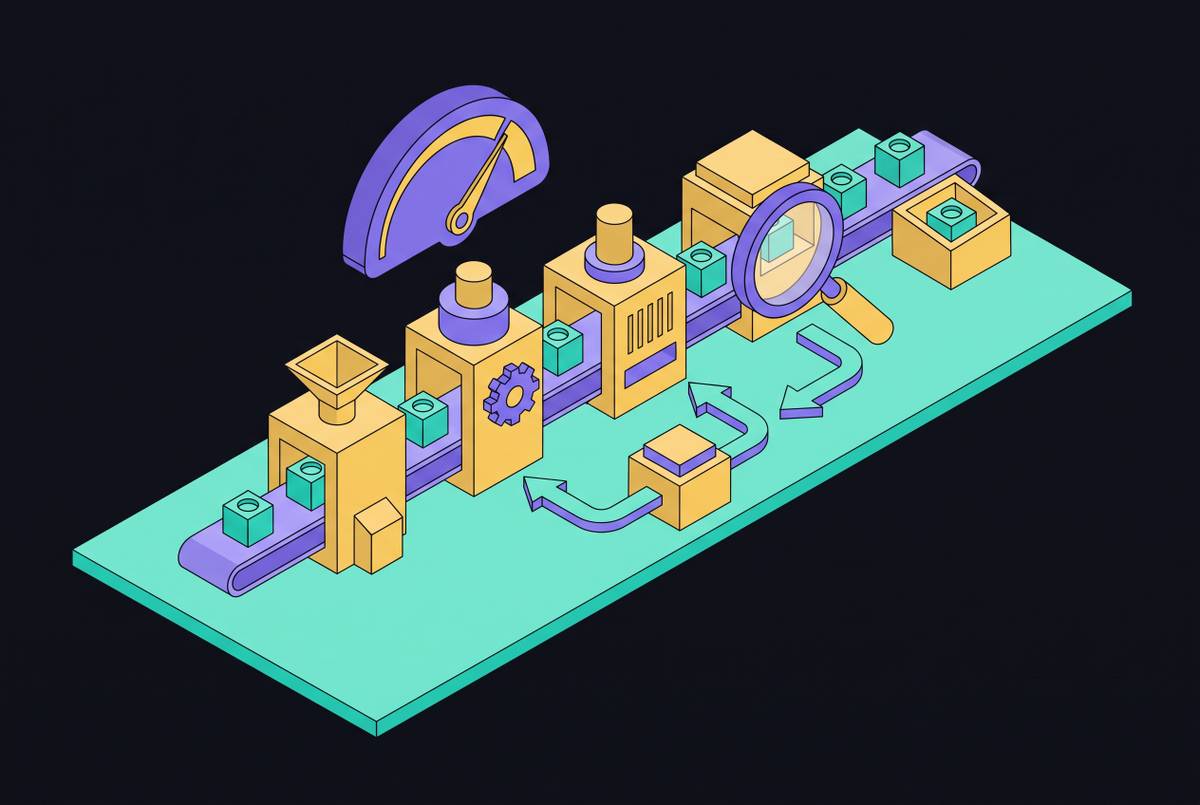
Finding shadow work starts with looking at what people actually do, not what the process documentation claims they do, and the most productive way to begin is with a specific painful process rather than a system-wide audit that tries to cover everything at once.
The starting point is a direct process audit: ask the operations team to walk through how a given process runs today, including every point where it hurts, every step where people quietly route around the system to get the job done. Five signals tend to surface the clearest evidence.
The first is the scorecard gap. When a performance metric shows strong compliance while downstream complaints keep coming in, the recording mechanism itself is broken. Mapping everything that happens between the moment a metric gets recorded and the moment a customer actually experiences the outcome usually reveals the shadow work directly.
The second is the approval trail. Trace every approval-dependent decision in a workflow and count how many are actually completed inside the system of record versus how many move by email, phone call, or verbal delegation. Every approval that happens outside the system is a documented instance of shadow work, not a guess about one.
The third is the handoff count. Any handoff that leaves no system record behind is a potential point where shadow work has taken root.
The fourth is the exception log. Look for the places where teams keep their own private records outside the official system, spreadsheets on a shared drive, personal notebooks, informal trackers nobody asked them to build. These records exist because the official system failed to capture something the team needed, and they function as a rough map of exactly where that failure occurs.
The fifth is what happens when a new employee asks how the process actually works. The answer to that question is, functionally, a description of the shadow process that actually runs the operation, passed along person to person because the formal system never captured it.
Shadow AI needs its own separate pass, because it won't surface through the same five signals. That means identifying which tools are connecting into operational systems, what permissions those tools actually hold, and whether any of those connections were set up without IT review. Agents embedded directly at the workflow level can be modifying operational state without anyone noticing, and that activity has to be scanned for deliberately rather than assumed to show up in a general process audit.
The objection worth taking seriously: some shadow work is load-bearing
Operations leaders who have watched an "improvement" project break something that was quietly working will raise a specific objection, and it deserves a direct answer rather than a brush-off: shadow work is often load-bearing. The workaround compensates for a real gap in the official process, a gap the official process itself doesn't acknowledge exists. If the workaround is removed without understanding what it's compensating for, the operation can end up worse off than before anyone touched it.
That objection is correct, and it's the reason identification has to come before any decision to eliminate a workaround, not an argument against identification itself. Shadow work should not simply be preserved out of caution, nor should it be eliminated on sight because it looks inefficient from the outside. Identification is a separate step from elimination. It's the step that makes elimination, formalization, or redesign possible without accidentally breaking something that's currently holding the operation together. A process rebuilt with its shadow work mapped into the design, the informal approval path formalized, the workaround surfaced and used as an actual input to the redesign, ends up more durable than a process that gets automated over the top of workarounds nobody bothered to understand first.
Organizations that skip straight to automation or redesign without this step tend to discover their load-bearing workarounds the hard way: when shipments stop moving, or when a compliance gap appears during an audit rather than during a planning meeting where it could have been addressed on favorable terms.
Where shadow work identification fits in a broader operational improvement effort
Shadow work identification is not itself the improvement: it determines whether any subsequent improvement effort, automation project, or AI deployment lands on the operation as it actually runs or on a declared version of that operation that stopped being accurate months or years ago.
The sequence that follows from everything above runs in a specific order: audit the process as it's actually performed, map the shadow work that surfaces, sort the load-bearing workarounds from the ones that are pure inefficiency, and only then decide what gets rebuilt. The rebuild decision has to follow the audit. It cannot come first.
This sequence matters most sharply where AI deployment is concerned. Logistics operations tend to be strong on the dimension of operational process discipline and measurable KPIs, and comparatively weaker on people and change management capacity. That imbalance means the underlying process needs to be understood before any agent gets introduced into it, because an agent deployed into an undocumented workflow will learn to operate the declared process on paper.
The goal is a specific, painful process, rebuilt first, with its shadow work identified and designed out. Organizations that invest time in process auditing before deploying AI consistently find that their first live process comes online faster and holds up longer than the processes deployed by organizations that skipped straight into undocumented workflows. The risk of skipping identification is also structural: it is a problem that compounds over time, as shadow work that gets automated rather than redesigned becomes embedded in the new system, where it grows progressively harder to see and more expensive to remove with each year it goes unaddressed.