Using Exception Logs to Map Process Failure Patterns
Exception logs reveal the broken patterns that process documentation deliberately hides.

A process schedule tells you what was supposed to happen. An exception log tells you what did. That gap between the two, intention versus execution, is where the real operational risk sits, and it's precisely where most automation efforts stall before they produce any value. Project schedules, standard operating procedures, declared workflows: these describe the path a process should follow. They are written before the work happens. That timing means they cannot capture what happens when the work runs into conditions nobody planned for. Exception logs are different. They record divergence in real time, making them one of the only sources of data that shows how a process actually behaves at the moment it runs.
A 2026 reference guide on AI logging and observability makes a version of this point directly: traditional application logs track what the code did, but AI systems need logs that answer what the model decided, why it picked a certain tool, what got fed into the prompt, and how that prompt changed over time. Those are questions no plan-based record can answer, because a plan only ever describes intended behavior. The same logic applies well outside of AI systems. Any process that runs under real conditions, staffed by people making judgment calls, will generate workarounds, informal handoffs, and quiet degradations that never make it into a document. The failure that results is rarely dramatic. The most common production failure pattern seen in 2026 is not a visible crash but a slow, invisible slide in quality that nobody notices until something further downstream breaks. Without a record of what happened at each decision point along the way, there's no way to reproduce the failure, explain it, or fix it. The process looks fine right up until it doesn't.
What traditional process audits and documentation systematically miss
Documentation describes intended-state logic. It lays out the path a process should take, and says almost nothing about the paths it actually takes once inputs get ambiguous, decision rules start to conflict, or a handoff between two teams quietly breaks down. That's not a sign that the documentation was written carelessly. It reflects something structural about when documentation gets written: before execution. Documentation is written before anyone has encountered the edge cases, exceptions, and informal fixes that always appear once a process meets the real world.
This is also why workflow automation so often fails on contact with reality. Automation breaks down when the underlying process has undefined inputs, inconsistent decision rules, or exception handling nobody ever resolved, and process documentation almost never records which of those three conditions is present, because the people who wrote it were describing the intended path, not the lived one. An audit built on that documentation inherits the same blind spot. An auditor walking through a documented process sees the designed logic laid out in front of them. What they don't see are the adaptations that practitioners have quietly built around that logic over months or years of actually doing the work.
The gap between declared process and actual execution is where real operational risk lives, and it's exactly where most automation efforts fail. Terminal Use, an AI-first operations rebuilder working in construction, logistics, manufacturing, and retail, starts every engagement by asking clients to show how a process actually runs today rather than the documented version, because a rebuild based on the documented version will merely speed up a process that was already broken. Organizations that audit their documented processes before automating are, in effect, auditing a fiction. They find gaps in the design. They do not find gaps in execution. Those are two different problems, and they call for two different remedies.
How exception logs expose the three failure patterns that plans never show
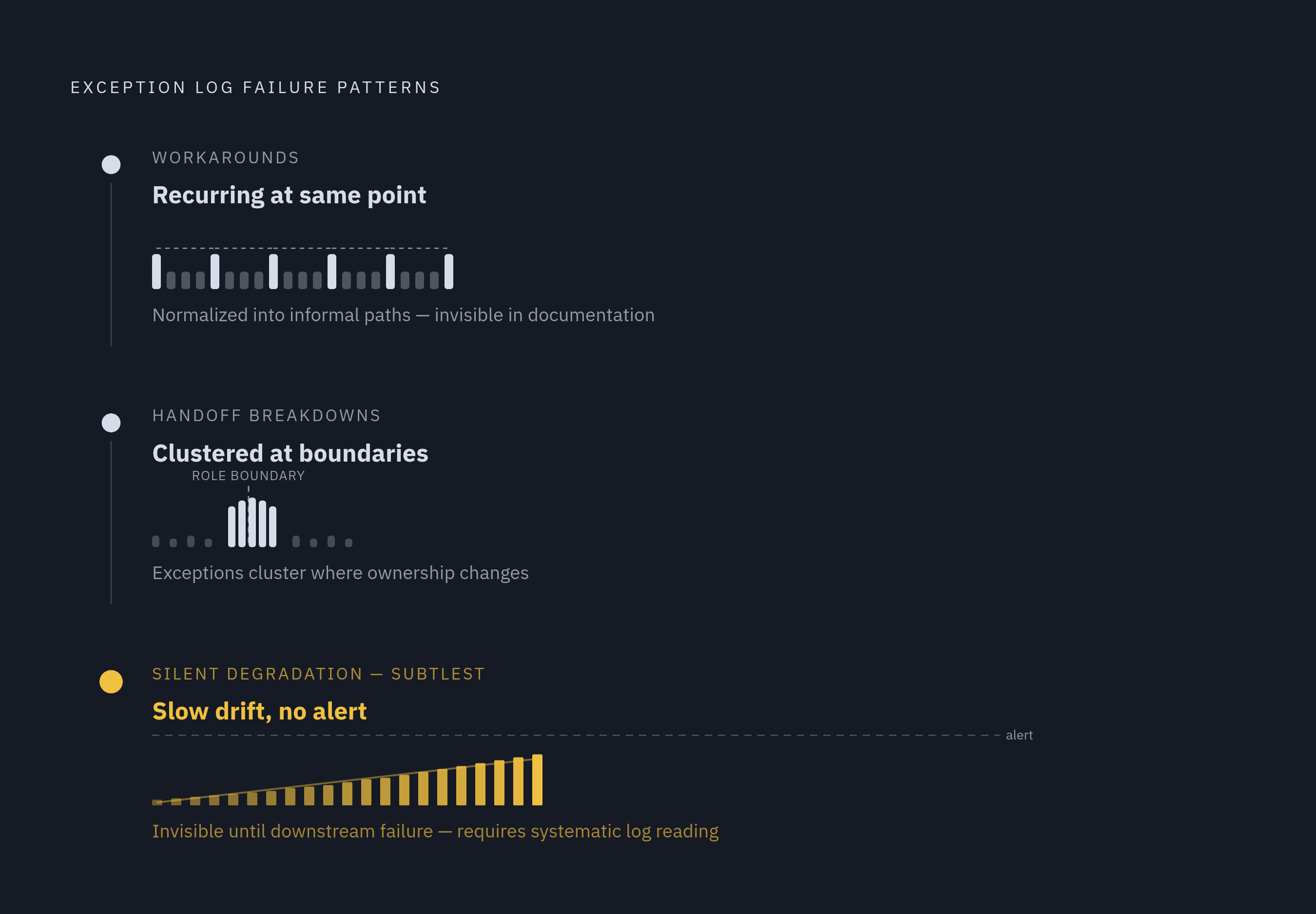
Read systematically, exception logs reveal three categories of failure that a declared plan is structurally incapable of showing: workarounds that practitioners have quietly normalized, handoff breakdowns between people or systems, and silent degradation that builds up long before anyone notices it.
Workarounds appear when a given process step throws an exception often enough that the people running it stop fighting it and build an informal path around it instead. That path never appears in any manual, but the log records it as a recurring exception type at the same point in the process, often clustered at predictable times or under predictable conditions. Handoff breakdowns look different: exceptions that cluster at the boundary between two roles, two systems, or two departments are almost always a coordination failure, and the log exposes exactly where ownership is unclear and where information that's supposed to transfer simply doesn't. Silent degradation is the subtlest of the three. The 2026 AI observability guide draws a useful distinction between binary error detection, where something either throws an exception or it doesn't, and spectrum-based quality decline, measured in things like hallucination rate or relevance score. The same distinction holds for ordinary operational processes, where quality can erode across hundreds of transactions before any single one of them is bad enough to trip an alert. Separate analysis of AI error handling makes the related point directly: quality decline caused by things like context window overflow, prompt injection, or bad upstream data does not register as an API error. Catching it requires logging the output itself, not just the code path that produced it.
What makes a pattern worth acting on is frequency. A single exception is noise. The same exception recurring at the same point in the process is evidence of something structurally wrong, and that difference only becomes visible when someone reads the logs across time rather than one incident at a time. The FAME framework for log anomaly detection shows this is tractable at scale: by sorting log event templates into failure domains using one LLM pass, then handing the ongoing classification work to lightweight on-premise models, it becomes possible to catch anomalies at the message level with high accuracy and far less manual annotation than reading logs line by line would require.
Process documentation captures intent, not adaptation. Process documentation omits the informal paths practitioners have built around recurring failures, the quiet workarounds that no audit of the intended workflow will ever surface. Exception logs make those adaptations visible as data, turning what operations teams have come to treat as normal into evidence of exactly where a process is genuinely broken and ready to be rebuilt.
Why high exception rates are the clearest signal that a process is not ready to automate
A process throwing a high rate of judgment-call exceptions, where people are regularly stepping outside the defined logic to deal with real cases as they come in, is telling the organization something specific: the "standard" path doesn't actually cover the volume of work going through it. This finding needs to be taken seriously before anyone talks about automating the process at all.
Automate that process anyway, and the automation will enforce whatever logic is written into the defined path, nothing more. The cases that don't fit the defined path still need to be handled by someone. They just no longer have a natural place to land, so they become manual cleanup work that compounds over time. This is the specific shape workflow automation failure takes when the underlying process has exception handling nobody ever resolved: the automation doesn't fix the broken process, it makes the broken process produce broken results faster, and it does so at scale.
Exception logs reveal this risk before a single dollar gets spent on automation. If the logs show that a large share of real-world cases require someone to override the standard path, that share reveals how much automation work actually remains, and it is almost always larger than what the documented process would suggest. Reading the logs first is the practical reason to do it before committing to any redesign or automation program: it tells an organization whether it's about to rebuild something that was actually working, or something that only looked like it was working on paper. The sequencing that follows from this is not subtle. A process redesign should start from the failure patterns the logs reveal, not from the intended-state logic written in the documentation. Rebuilding around the documented process instead will faithfully preserve every workaround and every handoff failure the exceptions were trying to flag in the first place.
How agents and AI-driven workflows create new exception categories that standard logs miss
AI agents running multi-step workflows fail in ways that a traditional exception log was never built to catch. A tool call can succeed, return a value that looks entirely plausible, and still have run on hallucinated parameters. By the time anyone notices, the side effect, a wrong record in the CRM, a document filed in the wrong place, a duplicate entry in the database, is already sitting in production, with no error anywhere in the log to point at it.
Guidance on production AI error handling names this as the central challenge of the field: the worst failures don't look like failures. The agent finishes its workflow. No exceptions get thrown. The downstream state is simply wrong, and nothing in a conventional log says so. A related failure mode is the silent loop, where an agent gets stuck rereading the same document or calling the same tool over and over, burning tokens until the task times out, with no exception thrown and no error logged at any point along the way. A standard exception log can't see this kind of failure, because nothing failed in the code-path sense that a standard log is built to catch. Research spanning more than 15 applications and five different coding agents found a structural bias in how these systems handle their own mistakes: agents consistently prioritize code that runs over code that's correct, and they suppress errors rather than surface them. That bias appears in the exception record as a false negative, a failure that looks, from the outside, exactly like success.
The 2026 AI observability guide concludes that logging an AI system properly means capturing prompts, completions, tool calls, and the decisions behind them, and it means treating model output as data sitting somewhere on a quality spectrum. The practical consequence for an operations leader is direct. An exception log built for a conventional workflow will systematically undercount the real failure rate of an AI-driven one, because the schema it was built on doesn't match the surface where these failures actually happen. Red Hat's Pipeline Failure Analyzer offers one working example of how to manage that surface rather than get overwhelmed by it: it restricts AI to exactly one of five pipeline stages, the stage that requires causal reasoning to group and diagnose root causes, and leaves the other four stages to deterministic code where structure is enough to do the job. That constraint keeps the log surface predictable and auditable rather than letting it balloon into something nobody can review.
What systematic log reading looks like in process-intensive operations
Systematic log reading is pattern recognition across time: which exception types keep recurring, at which points in the process, under which conditions, and how often relative to the total volume of work passing through.
The first practical task is separating noise from signal. Research into log anomaly detection using the FAME framework found that anomalies signaling real hardware faults, process crashes, or service degradation typically make up less than 5% of all generated log lines. The hard part isn't finding the exceptions, it's sorting them by failure domain and figuring out which clusters point to a structural problem in the process and which are just isolated, one-off incidents. Grouping exceptions by failure domain, meaning by shared upstream cause, turns out to be far more useful than tracking individual exception types on their own. FAME's architecture reflects that: an LLM sorts event templates into failure domains once, offline, and that sorting trains lightweight router and domain-expert classifiers that keep running continuously afterward, without needing to call an LLM on every single line that comes through.
Red Hat's Pipeline Failure Analyzer shows what a deployable version of this looks like in a CI/CD setting. Raw logs get cleaned and structured deterministically, along with the report assembly, ticket creation, and wiki publishing that follow, and AI is applied only at the grouping and root-cause stage, one of five stages in the pipeline. That constraint keeps inference costs bounded and the outputs predictable, while still allowing causal diagnosis across log volumes too large for any person to read line by line. Workarounds cluster as recurring exception types. Handoff breakdowns appear as exceptions clustered at the boundary between systems or roles. Silent degradation appears in quality metrics that never trip an alert on their own, even as it erodes outcomes across hundreds of transactions. Reading logs systematically turns these three patterns into something an operations team can act on, and that diagnostic work has to happen before any process gets rebuilt with AI agents at its center. What comes out of this work should be a map: which points in the process are structurally fragile, which handoffs break down repeatedly, and which exception types are growing month over month. That map holds up as a starting brief for a redesign conversation far better than any declared process description, because it reflects what the process actually does under real conditions, not what someone intended it to do on the day they wrote the documentation.
Why the pattern map, not the exception count, is what drives a process redesign
Exception logs capture symptoms. The pattern map built from them identifies the system behind those symptoms, and that system-level view justifies a redesign decision rather than a quick patch on whichever exception got flagged most recently. A fair objection is that exception logs only ever show symptoms, not causes, and that a mandate to redesign a process requires understanding the system underneath it, not just the list of things that went wrong. Systematic pattern mapping is how you get from symptom to system: a recurring exception, at the same process point, in the same failure domain, under predictable conditions, is structural evidence.
A process audit that starts from the failure pattern map asks a different question than one that starts from the documented process. Instead of asking whether a given step matches the design, it asks why that step keeps failing in the same way, and what that pattern says about the decision logic or the handoff structure feeding into it. The redesign conversation that follows is grounded in what the process actually does in the field, not in the documented plan's picture of what it's supposed to do. Rebuilding something that was genuinely broken is different from patching the document that described it.
For operations leaders in construction, logistics, manufacturing, and retail, where process complexity runs high and failure carries direct operational and financial consequences, the pattern map is the most reliable brief available before committing to an AI-first rebuild. It points to the specific, painful process point where a redesign will do the most good, rather than spreading effort thin across a broad transformation roadmap that treats every process as equally urgent. The place to start is always the same: show how the process actually runs today, where it hurts, and what the exception record says about why, before deciding what to rebuild first.