Why Dispatch Bottlenecks Beat Infrastructure Gaps as the First AI Deployment Target in Construction
Start with dispatch handoffs, not a rebuild, to get AI gains fast.
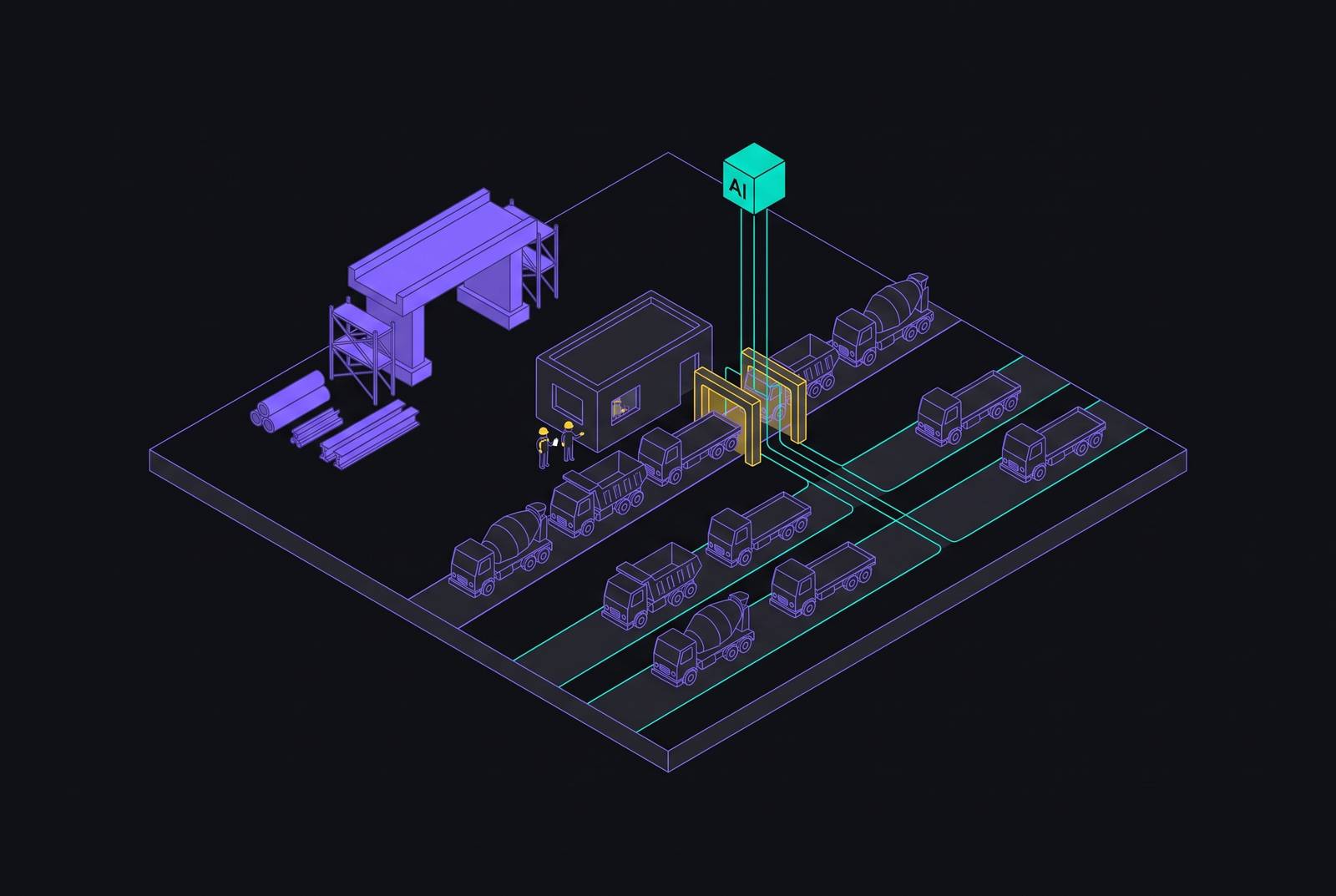
Construction operations leaders can deploy AI without a years-long IT project by starting with dispatch handoffs on systems the site already has. Dispatch-first is a sequencing decision. A bounded workflow can produce measurable gains in weeks while preserving human judgment and operational closure, giving the organization evidence for broader change before it commits to a rebuild.
Why construction dispatch lives in the handoffs, not the systems
A vendor email contains a delivery update, the P6 schedule holds the planned sequence, and a field status report describes conditions on site. Yet a dispatcher still has to connect them. The TMS, ERP, and project controls platforms each hold part of the picture, but no single part tells the team what needs attention across the workflow. A person must notice information in one place and act on it in another.
Late pickups, missed appointments, driver communication gaps, and exceptions need someone to follow up by hand even when the systems are working. The resulting small fires can look like evidence that the software is inadequate, when the immediate failure is the handoff between tools. This distinction determines the first deployment target because replacing a system and connecting an unfinished workflow are different interventions.
Why infrastructure gaps look like the right target but are not the right first move
The infrastructure-first instinct has a sound basis. Legacy WMS, TMS, and ERP systems were built before APIs were standard, and operations leaders who have watched data-pipeline projects stall have reason to see integration debt as a root cause. A fragmented foundation limits what the organization can coordinate. Fixing it can thus seem like something that must come first, ahead of other work.
The difficulty is the sequence of cost and benefit. Infrastructure rebuilds touch many systems, demand broad stakeholder alignment, and expose the organization to extensive process change before the full rebuild produces a measurable operational result. Making the rebuild a prerequisite leaves the manual handoffs in place while the organization undertakes its most demanding technical and organizational work.
The strongest objection to dispatch-first is operational closure. If an agent works outside the enterprise transaction backbone, shipment exceptions and service events may never reach the ERP or adjacent systems. Agents should be scoped to write back the information the workflow needs, on top of existing systems and without migration. In the first deployment, people can review those updates so the workflow closes without a full rebuild.
What dispatch bottlenecks actually cost a construction project in schedule terms
The cost of leaving those handoffs unresolved extends beyond dispatcher time. Material delivery, crew deployment, and subcontractor sequencing all depend on dispatch, so delays can propagate into the project schedule. A late input is not merely an incomplete record. It can leave the people coordinating downstream work acting on a plan that no longer reflects conditions.
The P6 schedule is that plan. Dispatch activity, procurement logs, vendor emails, and field updates together hold the information needed to make sense of it. When those inputs arrive late or out of sync, the gap between the model and reality can widen faster than monthly update cycles close it. The reporting cadence then becomes part of the problem. A schedule model that is weeks behind conditions shows what happened too late for the team to change course while there is still time.
This makes the schedule cost of dispatch lag structural. It concentrates where the schedule meets procurement status and vendor communication, because those handoffs connect planned work to the information needed to coordinate it. Dispatch automation targets that territory directly rather than treating all project data as equally urgent. Its early value therefore rests on whether it shortens a consequential delay in the workflow.
How can construction teams deploy dispatch AI on systems they already have?
Dispatch automation can operate on the existing TMS and communication layer without a data-pipeline rebuild, migration, or new system of record. The architecture is deliberately narrower than infrastructure replacement. An agent reads information from systems already running and writes back only what the defined workflow requires. That scope makes the work more tractable, though it does not remove the need to define how the workflow closes.
The mechanism replaces human check-call loops with agentic monitoring. Agents can pull ELD and GPS signals, parse carrier replies, and surface exceptions that require a human decision. The dispatcher's judgment remains in the process. What moves to the agent is routine pattern recognition and follow-up, rather than responsibility for every decision that follows from an exception.
ServiceTitan's 2025 overview identifies AI-powered project management and scheduling as clear near-term applications in construction. It frames real-time progress tracking and automatic issue detection as capabilities built on existing management platforms. That distinction supports the dispatch-first architecture.
What production deployments show about the speed and scope of dispatch automation
Airlite Plastics used an agent to take over dispatch work the team had to do over and over. Senior Director of Supply Chain Jeremy Forster said that Shipwell's Track & Trace AI Worker handled tracking updates the team had done by hand. Over the course of the beta, the company had practically eliminated an hour a day spent sending carrier emails and uncovering delivery details for invoicing. The gain was limited to this dispatch work. The gain came from removing recurring status and delivery-detail work while keeping the supply chain's systems in place.
Carrier follow-up and delivery-detail collection are bounded tasks with recurring patterns, even when the larger project is complex. They are a different starting point from asking an agent to reconcile every operational dependency. The reported saving also has a defined measurement period, namely the beta. It shows that a workflow can improve quickly in ways the team can measure, though it sets no deadline that every deployment must meet.
Canadian furniture brand Sundays illustrates a different facet of the problem through Cartage's agent, Wilson. Cartage's founders identified shipping providers' different software and portals as the source of tangled coordination, with customers reverting to phone and email. Its case study describes Sundays deploying Wilson for quoting, booking, tracking, and auditing shipments. The problem crosses company boundaries as well as systems. Construction logistics works much the same way, with vendors and subcontractors using different tools to coordinate shared work.
The two cases support different parts of the argument. Airlite demonstrates the value of taking repetitive manual follow-up out of a team's day, while Sundays illustrates how an agent can span a multi-provider workflow without platform consolidation. Neither supplies a measured construction schedule outcome. The shared handoff mechanism gives construction leaders a pattern they can use for deployment, without assuming they will get the same results as another industry.
Why change management, not technology, determines whether dispatch automation holds
For operations leaders, the practical warning is that a functioning agent does not establish a functioning handover. A dispatcher may override a recommendation to avoid an uncomfortable customer conversation, or a driver may reject a route that appears to add complexity. The agent's output then fails to change the work. Technical performance cannot compensate for a team that continues to operate around the deployment.
This resistance appears quickly because dispatch recommendations immediately touch daily habits. Infrastructure programs encounter the same underlying adoption problem, but a dispatch workflow exposes it at the point where people must decide whether to act differently. An agent can be quietly ignored after launch. In that situation, further configuration alone does not resolve the fact that responsibility for the routine work was never actually handed over.
Engineers who sit with the dispatch team and learn how the work runs can address the handover as part of deployment. That work includes learning which decisions stay with people and which recommendations people resist. Dispatch-first makes that change easier to manage because it is scoped and observable, with a small team, a defined workflow, and a measurable handover rather than department-wide change without early feedback.
How to read a dispatch workflow for the first agent target
An operations leader should ask the dispatch team where an experienced person spends the most time doing work that follows a pattern they could describe in a rulebook. The answer identifies a stronger first candidate than the most visible or expensive failure alone. High volume, clear rules, and real business pain must coincide. Complexity by itself is not a reason to begin there.
Exception handling is a likely place to look. Late pickups, missed appointments, and driver communication gaps generate a recurring stream of problems that dispatchers sort manually. The useful distinction is between recognizing the exception and deciding how to resolve it. Where recognition follows a clear pattern but resolution needs judgment, the agent can take the routine portion while the dispatcher retains the decision.
Another strong place to start is following up on carrier status and documents. Pulling delivery details, chasing PODs, and updating billing records take time from experienced staff even when the work may not need their judgment. These tasks also give the team something concrete to describe during the diagnostic conversation. Rather than discussing AI in the abstract, the team can identify the repeated follow-up that keeps a known workflow moving.
Coordinating vendors and subcontractors there links dispatch information to the planned sequence of work, so delays can affect the schedule as well as the paperwork. The first target still needs clear rules. A high schedule cost does not by itself make the entire coordination problem suitable for an initial agent deployment.
The first deployment should also keep human review in place before agent output enters a system of record. Trust is earned through validated performance on lower-stakes tasks. This constraint is compatible with operational closure because reviewed output can still complete the workflow. The conversation should therefore establish both the repetitive work to transfer and the decision boundary to retain, rather than treating automation as an all-or-nothing handover.
What whole-department transformation looks like once dispatch proves the model
A successful dispatch deployment creates a basis for broader operations change. The same agent architecture can extend from carrier check calls and exception routing to bid and proposal coordination, procurement-to-schedule reconciliation, and subcontractor communication. These are further handoffs. Their suitability follows from the workflow pattern, while their deployment depends on what the organization has learned from the first implementation.
That learning makes later deployments faster to organize. The team knows which work the agent handles reliably, which decisions remain human, and how to manage the transition from manual effort to agent-supported execution. The organization has a tested handover pattern. It can apply that knowledge to harder workflows rather than reopening every question about responsibility and adoption with each new deployment.
For construction, the highest-value extension connects the P6 schedule, procurement logs, vendor emails, and field updates. Today, that cross-system handoff requires project controls teams to reconcile and report information that can be weeks behind conditions. Using the dispatch model for this handoff changes how the reconciliation work gets done. The goal is an end-to-end operating change.
Infrastructure work is still part of that broader change. Dispatch does not have to be the department's most important problem to be the right place to spend credibility and political capital first. It offers a bounded way to demonstrate results and learn how work can be handed over successfully. That proof makes the next, harder transformation easier to undertake.