AI Agent Roles in Procurement Workflows
Specialized agents move procurement work forward while keeping humans in control of commitments.
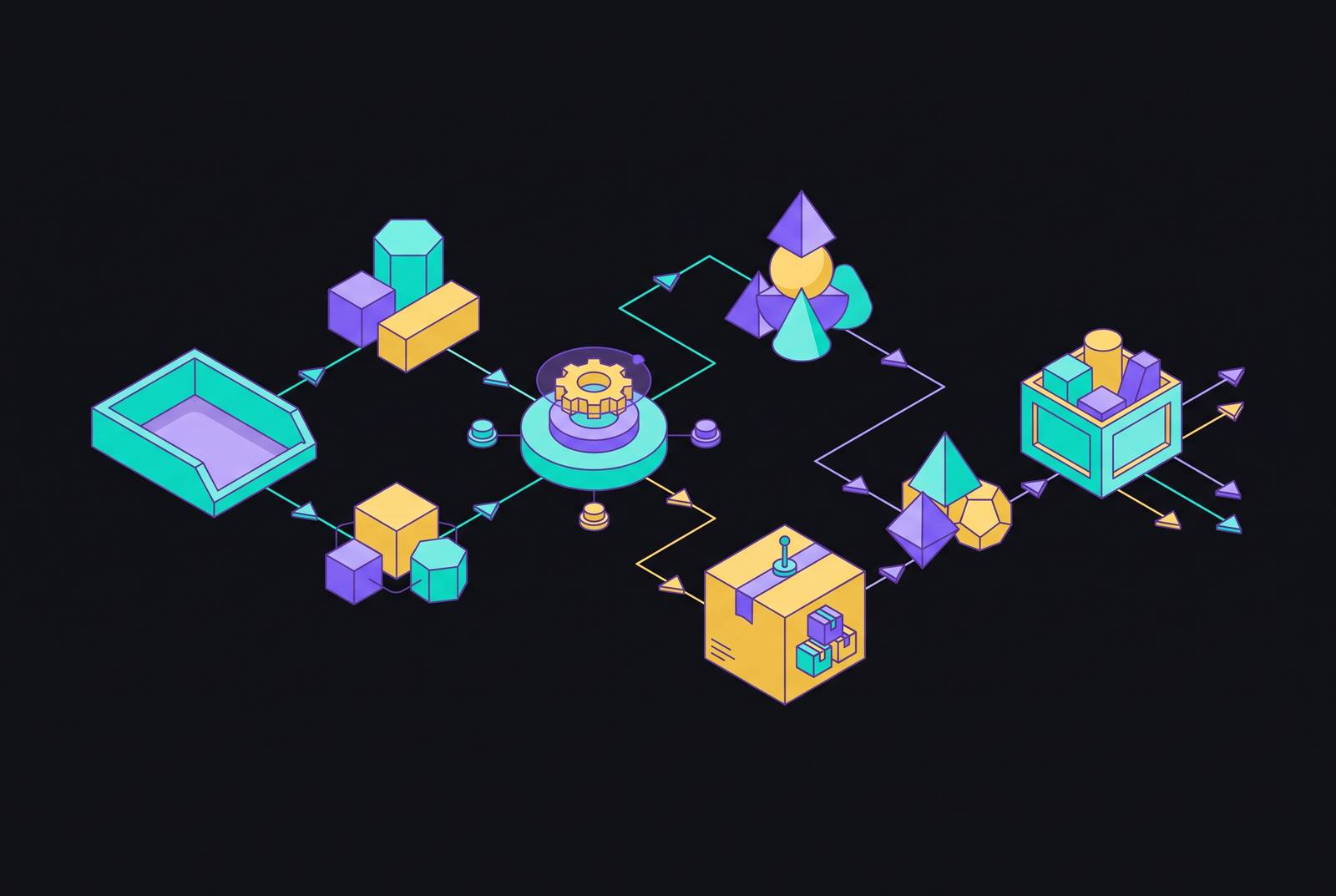
Sourcing, supplier risk monitoring, contract intelligence, and approval routing each do a different job to fill a gap in how procurement works. A deployable design gives each role the context, system access, and authority its work requires, while preserving human control over commitments that demand judgment.
Why procurement is structurally suited to autonomous agent execution
Procurement combines high data volume, repeatable procedures, and constant exceptions. Contracts, RFQ responses, supplier emails, invoice PDFs, and regulatory filings contain information that has historically required manual processing. McKinsey estimates that procurement functions use less than a fifth of the data available to them when making decisions. The gap is therefore not simply a shortage of information. It is the difficulty of turning that information into action within a working process.
Those processes have enough structure to automate, but they vary enough to reach the limits of rigid, rule-based automation. A supplier may not respond, an invoice format may change, or an approval threshold may differ by category or region. The sequence remains recognizable even when its next step requires interpretation. This is where autonomous execution differs from software that displays information and waits for someone to act.
Procurement also has infrastructure and controls that agents can work within. Most enterprise functions already use ERP systems, contract management tools, and supplier portals, so agents can connect to existing systems. Financial, compliance, and operational risks already require audit trails, which agents that generate logs natively can support. These conditions make procurement a strong fit, but they do not define a single job for an agent. Deployment design must match a specific role to the gap that prevents a particular workflow from advancing.
Why a single general-purpose procurement bot fails where specialized agents succeed
Finding a supplier is not the same task as assessing its financial exposure, interpreting a contract, or authorizing a purchase. A general-purpose bot may answer questions about all of these tasks without keeping the workflow moving from one to the next. Specialized agents each have a defined job and pass context to each other across the procurement lifecycle.
That handoff depends on persistent project state. Supplier qualification can take weeks, contract negotiation can last for months, and a multi-round RFP can have dozens of points where a decision is needed. A stateless tool that resets between interactions cannot reliably retain a revised budget or a prior compliance flag. When work resumes, an agent working on the event must still have its budget, stakeholders, evaluation criteria, and the history that matters to the work.
A large multinational division illustrates the operational distinction. Its initial project for pre-programmed background agents evolved into a stateful, multi-channel orchestration platform, with specialized agents forming and reforming groups around task requirements. A sourcing agent hands context to a risk agent, which escalates to a compliance agent when thresholds are crossed. Human gateways remain part of the architecture for complex and high-value decisions, so specialization changes how work moves without removing accountability.
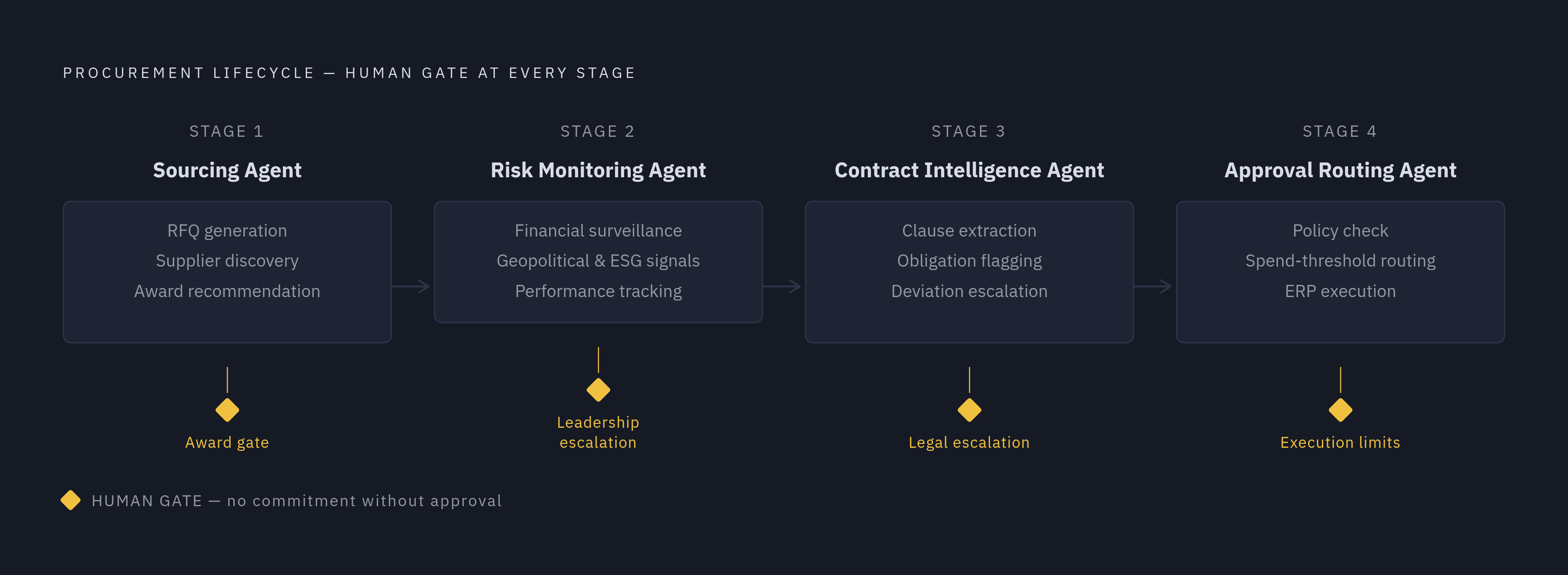
The sourcing agent — autonomous RFQ generation and supplier discovery
The sourcing agent closes the gap between a procurement trigger and a qualified shortlist. Before an RFQ can go out, category managers must identify suppliers, gather performance history, check certifications, and assemble bid packages. They must then collect and score responses. For specialized or rare categories, this work can consume many weeks of senior procurement time because each step depends on information gathered in the previous one.
A web agent identifies potential suppliers from internal databases and external sources, while a quality agent validates them against policy and regulatory requirements. A document agent retrieves certifications, performance history, and prior transaction data. The sourcing agent then assembles and distributes bid packages, collects responses, scores them against weighted criteria, and presents a shortlist with an award recommendation.
To make that recommendation actionable, the agent must read internal supplier databases and write bid outcomes back to ERP and contract management systems. In asset-heavy industries such as construction, it must also read the project schedule to forecast material needs, flag price volatility, and recommend order timing. It needs that connection to catch mismatches between purchase orders, deliveries, and the sequence of work that follows. The completed analysis still stops at a human gate before commitment. The agent shortens the sourcing cycle, while the award decision remains subject to review.
The supplier risk monitoring agent — continuous surveillance versus periodic review
Supplier risk continues after the sourcing event because a qualified supplier can face new risks during the relationship. The interval between a warning signal and a disruption can be shorter than a human review cycle. A risk monitoring agent therefore keeps track of financial health, geopolitical exposure, ESG scores, and performance metrics all the time. When risk goes above the set thresholds, it alerts procurement leadership and suggests other suppliers.
The operational distinction is the response workflow. The agent must read external financial indicators and news signals, cross-reference them against supplier performance data in the ERP, and have authority to initiate escalation. Read-only access can produce insight, but it cannot close the gap between detection and response. Zip's Adverse Media Agent uses a simple-reflex foundation that raises a flag when predefined risk conditions are met. A more capable version supplements binary flags with predictive scoring from combined financial, ESG, and performance signals.
In construction and infrastructure, delays to long-lead power items, including switchgear, transformers, and UPS systems, can cascade into energization failures that acceleration elsewhere cannot recover. Checking lead times against installation milestones gives an early warning that a periodic review can miss. Yet continuous monitoring loses value if it generates more alerts than teams can use. False-positive fatigue makes threshold calibration part of the role's design, with sensitivity varying by category criticality and spend level. Leadership receives the escalation, while the agent supplies the signals and proposed alternatives needed for a response.
The contract intelligence agent — extracting obligations and flagging risk before signature
JPMorgan COiN, or Contract Intelligence, reviews commercial loan agreements and finds the terms and deviations that matter in seconds. The same review used to take 360,000 legal hours a year. Its model-based reflex pattern evaluates a document against a known model of what should be present. The procurement application follows that logic, although its purpose is to identify contractual obligations and risk before a purchasing commitment is made.
A contract intelligence agent scans renewal terms, extracts obligations, detects non-standard clauses, and escalates high-risk language to legal teams. This is more specific than summarization because the output determines where review is needed. The agent moves the document into the appropriate workflow rather than leaving someone to interpret a summary and decide what to do next. It can also link what it finds in clauses to downstream P2P automation, taking the work beyond legal review toward making payments.
That connection requires access to contract repositories and the ability to write findings into contract management and approval systems. A summary PDF that leaves the system of record unchanged adds another handoff. In regulated industries, native audit trails must also log sourcing decisions, exception approvals, and vendor selections in a format that satisfies procurement compliance frameworks. These records do not replace substantive review. Clause extraction and deviation flagging remain distinct from legal judgment on novel or highly negotiated terms. The agent's escalation path is therefore a necessary part of its role.
The approval routing agent — closing the loop between decision and execution
Approval routing needs real-time ERP read and write access to carry out procurement work as well as report on it. An agent that cannot interact with SAP, Oracle, or Coupa cannot close approval loops or execute purchase orders. A person must enter its recommendation again, bringing back the manual step the agent was meant to remove. At this point, all the upstream sourcing, risk, and contract work either reaches an authorized transaction or stalls.
The approval routing agent evaluates an intake request, checks policy, gathers supplier context, and identifies the approval path. It routes the request to an approver or executes directly under the rules based on spend threshold, category, and entity. Regional policies also set limits on what the agent can do on its own. Standardized sourcing events, tail spend, and repeat orders are good choices for work that agents can do fully or almost fully on their own. People remain responsible for strategic sourcing, complex negotiations, and high-value financial commitments.
The same role can close the invoice-matching loop. It can verify goods delivery, check payment eligibility, query the ERP, identify exceptions, and draft resolutions before routing for approval or executing where permitted. The governing distinction is not whether the agent can perform the task, but whether it has authority to complete that particular transaction. Approval routing therefore preserves human accountability formally, through rules and escalation paths, rather than treating it as an informal check after execution.
The governance structure that determines whether each role operates safely or creates new risk
Governance makes these roles deployable when it reflects their different powers. Gartner identifies binary treatment, in which agents are either locked down or fully trusted, as the root of two failure modes. Over-restricting simple agents slows delivery and drives shadow development, while under-restricting more autonomous agents raises operational, security, and compliance risk. An invoice coding agent and a sourcing agent running multi-round RFPs therefore need different controls to match the work they do.
Governance gaps allow action outside policy, while transparency gaps prevent reviewers from reconstructing agent actions. Coordination gaps let collaborating agents drift out of step, and safety gaps allow untrusted content to contaminate trusted reasoning. Plateaued improvement occurs when deployments stop improving despite model upgrades. In procurement, these are operational design problems because the roles exchange context and act through shared business systems.
Agent-specific risks also include tool misuse, context loss, goal drift, retry loops, cascading errors, and silent quality degradation. A multi-agent procurement workflow adds the possibility that an error passes from one role to another. In construction, hallucinations embedded in schedules, estimates, or commercial documents make transparency consequential beyond compliance. The practical response is governance differentiated by agent type and autonomy level. Sourcing requires an award gate, risk monitoring requires calibrated thresholds, contract intelligence requires legal escalation, and approval routing requires explicit execution limits, with reconstructable actions across the flow.
Why the process must be rebuilt before the agent is deployed
Every role described above assumes a process coherent enough for an agent to follow. That assumption fails when RFQ procedures vary by project manager, submittal routing depends on who is available, or spend records remain fragmented across business units. Different currencies and taxonomies can make spend analysis misleading. An agent cannot resolve this inconsistency simply by processing the records faster.
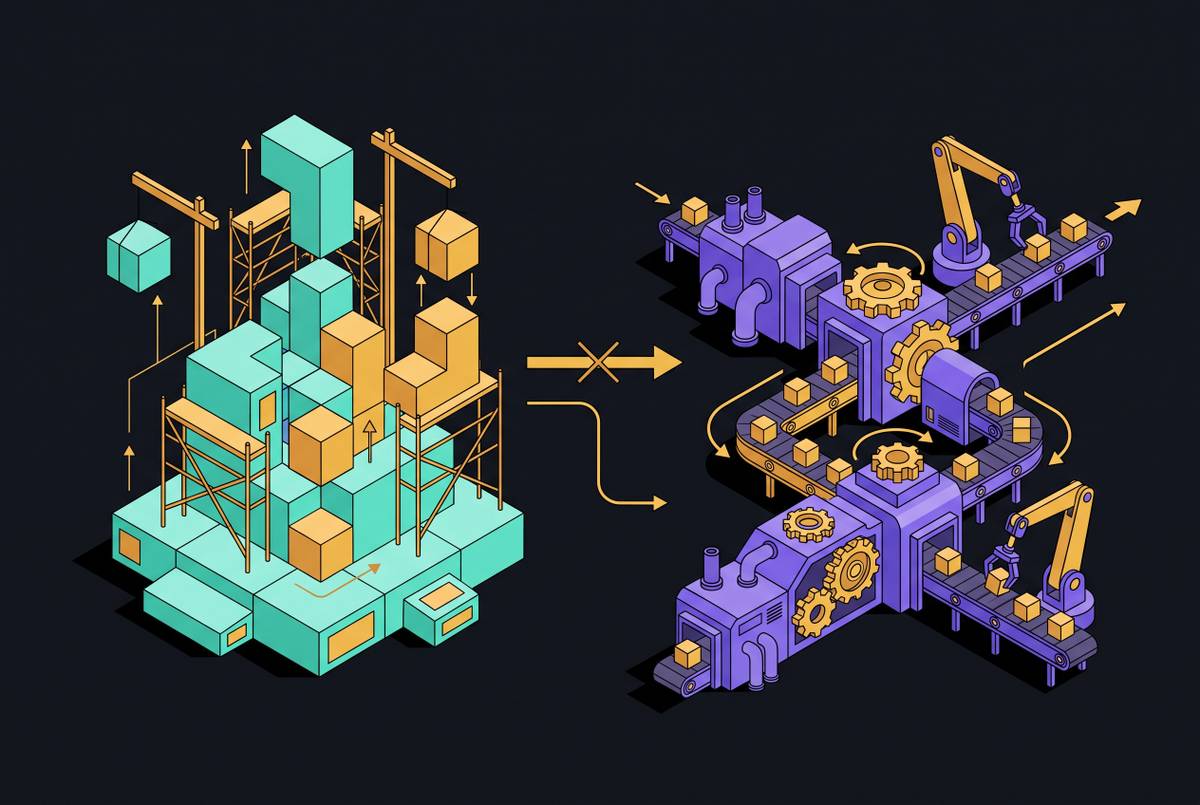
If category managers compare bids by hand again because they cannot trust inputs that are inconsistent or procedures that vary, the cycle takes just as long even when the agent produces results fast. Layering an agent onto that process instead executes the inconsistency faster and at greater scale. Process redesign is therefore a precondition for reliable automation.
A process audit establishes that precondition by mapping how the workflow runs today and where it breaks. It identifies the first role to deploy and the system connections needed to close the gap. Enterprises moving beyond pilots follow a sequence of choosing a narrow use case with predefined success criteria, measuring ROI against those criteria, and expanding by redesigning workflows around the agent. Deployment begins with a specific, painful process, such as a narrow-category sourcing event that takes weeks or an approval loop stalled at one threshold. Map and repair that process, get the first agent live, measure the result, and then expand.