Designing Human-in-the-Loop Steps for AI-First Operations
Effective human review requires placing judgment where decisions have irreversible consequences.
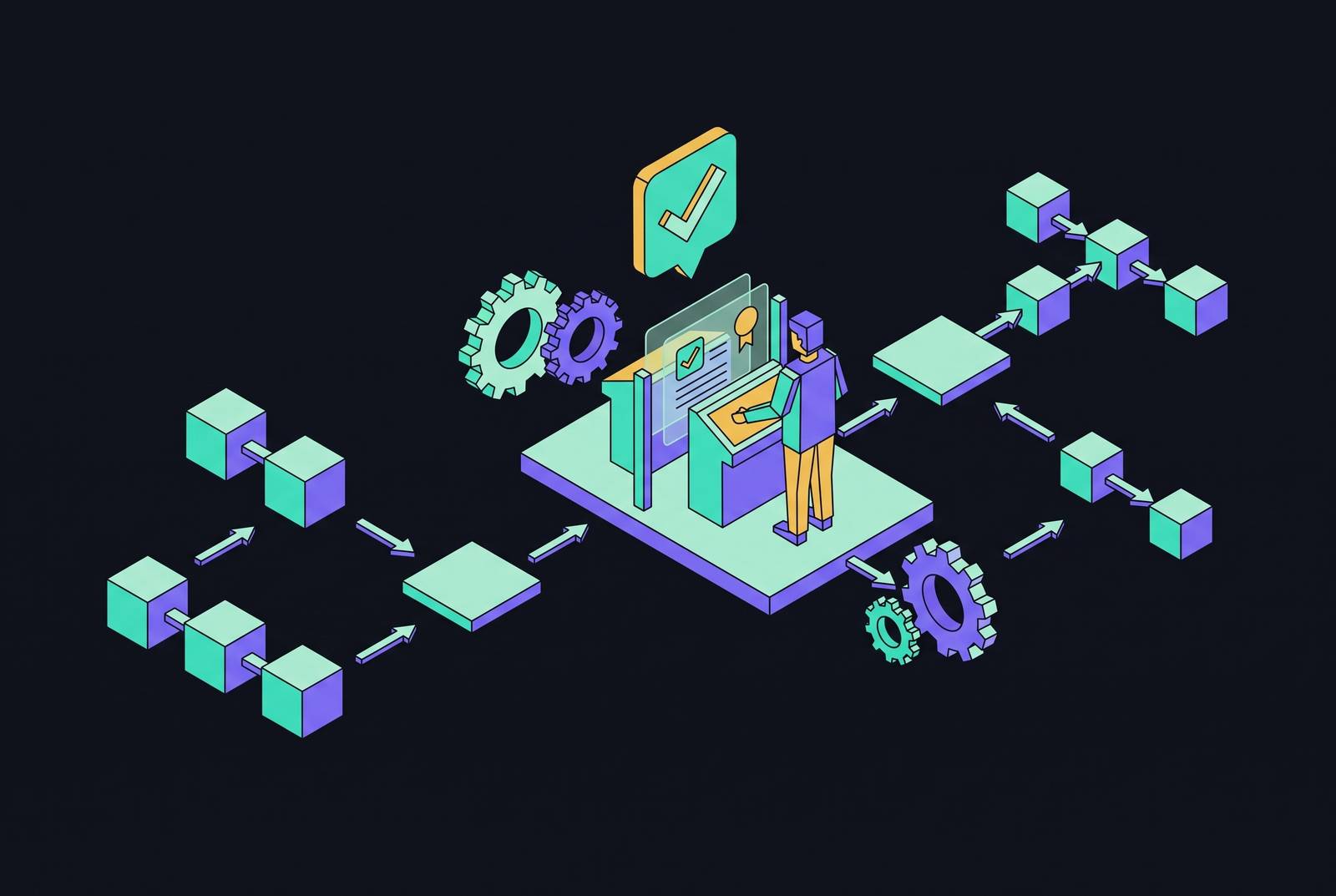
Human-in-the-loop design for AI-first operations places judgment where it changes outcomes. Effective intervention points address commercial ambiguity, coordination gaps, and irreversible decisions that automation cannot reliably resolve. Building them requires process redesign, clear authority, and usable context.
Why placing humans in AI workflows is a design problem, not a policy problem
A review step earns its place only if the reviewer can change the decision. Otherwise, it adds delay while leaving the underlying risk untouched. The dominant failure in AI-first operations is therefore not removing people entirely, but placing them where their presence adds friction without improving the outcome. A checkpoint that merely approves an agent’s output is not a substitute for a judgment-bearing role.
A policy can name a reviewer without giving that person the training, authority, time, or information needed to evaluate the output. The resulting oversight exists on paper but not in effect. To design an intervention that helps, teams must pin down the decision, the agent’s likely failure mode, and what happens if it acts incorrectly. Hallucination, context overflow, and brittleness with novel inputs matter differently depending on whether an error can be corrected locally or commits the operation to an irreversible course.
What AI agents actually do well and where their failure modes concentrate
Modern agentic workflows reliably handle high-volume, pattern-based work, including extracting, classifying, validating, matching, routing, and closing loops across systems. Invoice processing shows why this capability extends beyond reading fields from a clean document. The process also involves non-standard inputs, missing dates, ambiguous currency, vendor matching, PO validation, and downstream decisions. Layered inference can resolve these connected tasks autonomously at scale.
Failures concentrate where the available patterns no longer establish a reliable answer. Ambiguous vendor terms may require commercial judgment, while a procurement exception may have no useful precedent. Coordination gaps create a different problem because the relevant context sits across trades or systems. In multi-agent construction and logistics workflows, a procurement error can propagate into production scheduling and then logistics, creating disruptions that take weeks to unwind. This cascade does not require a catastrophic failure by any single agent, only communication between agents without an isolated failure boundary.
The three categories of decision that require human judgment in an AI-first workflow
Not every exception belongs in a human queue. Many unusual inputs remain resolvable through further validation or inference. Human placement becomes necessary when the decision contains ambiguity, consequence, or accountability that automation cannot resolve on its own. Three categories distinguish those decisions from routine exceptions.
The first category is an ambiguous call with commercial consequence. A procurement decision may depend simultaneously on supplier reliability history, relationship context, and delivery risk, with incomplete or contradictory inputs. A model’s confidence score cannot settle the commercial trade-off between those factors. Confidence-threshold escalation remains useful, with high-confidence outputs proceeding automatically and low-confidence outputs reaching review. But the threshold must account for what a wrong answer would cost the business as well as how certain the model is.
The second category is a coordination gap between systems or parties. An agent may have all the structured data while lacking the relational context that determines what the data means. At a handoff between schedule, procurement, and commissioning, recorded inputs may show that everything required is in place. A field coordinator may still need to judge whether to trust a supplier’s verbal confirmation of delivery timing based on the history of their relationship.
The third category is an irreversible gate. Here, correction after execution would cost more, take longer, or fail to undo the harm. Energization readiness is the clearest case because power systems, panels, and utilities must be commissioned and cleared before crews mobilize. Human review at energization signoff is a mandatory gate justified by the irreversible consequence of commissioning a power system incorrectly, and cannot be engineered away by raising a confidence threshold.
How the human role changes across a layered inference architecture
Governing a system is not the same task as intervening in one of its decisions. The distinction between human-on-the-loop and human-in-the-loop therefore concerns expertise, authority, and timing. Setting risk limits, validating process logic, interpreting model failures, and resolving field exceptions are separate functions. Treating them as interchangeable leaves important judgments without a capable owner.
Operations leaders define unacceptable risk and the point at which autonomous resolution ends. Domain experts validate extracted logic before it enters a redesigned process, particularly when AI surfaces embedded rules from legacy systems that were never formally documented. Engineers interpret edge cases where statistical prediction collides with business reality, drawing on technical and operational understanding. Field coordinators address the procurement, coordination, and commissioning calls that fall outside the governance layer’s thresholds.
In this architecture, AI executes by default and humans govern by exception. That makes exception routing part of the system’s design. The routing must connect the decision to the person with the context and authority to act. Without that differentiation, reviewers receive outputs they cannot meaningfully evaluate and default to approval to clear their queues.
Why process redesign, not tool addition, determines whether HITL placements actually work
Even a review placed at the right point will fail if the process around it cannot support it. Reviewers need access to the relevant information, authority over the decision, and tooling that lets them act. Those conditions must be structural features of the redesigned workflow.
The recurring mistake is neglecting the process and change management work that deployment requires. A capable model cannot compensate for a workflow whose escalation paths are broken. In construction and logistics, an agent may correctly flag a procurement delivery risk yet change nothing because the alert lands in an inbox that no authorized person monitors in real time. The intervention exists in the architecture but not in the operation. Improving the model’s accuracy does not repair that disconnect.
A process audit is therefore a design prerequisite. It identifies where coordination actually breaks down, where decisions lack documented authority, and where the declared workflow differs from the lived one. These differences determine what an intervention point must connect and who must own it. Starting with a specific, painful process whose failure costs are visible and attributable avoids postponing those choices through a platform strategy.
Regulatory pressure as a design forcing function, not just a compliance burden
The EU AI Act Article 14 specifies what human oversight must be capable of doing, including understanding system capacities and limitations, interpreting outputs, and overriding or reversing decisions. It does not prescribe the exact location of a review step within an operation. The NIST AI Risk Management Framework also brings human oversight into the design of risk management.
These capabilities cannot be supplied by a policy reference alone. A designated reviewer who cannot interpret the output or intervene in the decision does not provide the required operational control. Logging and audit duties are separate from Article 14 and are addressed under Articles 12, 19, and 26(6). Keeping that distinction clear matters because the ability to intervene and the evidence that an intervention occurred are related but different design requirements.
The gap becomes visible when documentation describes controls that no longer match the deployed workflow. An auditor asks for evidence, but the system has changed without the controls being redesigned. Building intervention points that are logged, attributable, and reviewable addresses that gap within the operational design.
What well-designed human intervention points look like in construction and logistics operations
Construction procurement shows how commercial ambiguity emerges from otherwise routine automation. Agents can organize vendor quotes, purchase orders, delivery records, invoices, and inventory data, while automating three-way matching of delivery slips to POs and invoices. The intervention point arises when a quoted lead time conflicts with field intelligence about supplier reliability. A billing discrepancy can similarly require commercial authority to decide whether to escalate or resolve it. The agent assembles and flags the issue, but the human closes the judgment gap.
AI tools can identify leading indicators of delay across a project portfolio and flag high-risk projects for early management attention. Yet the flag has value only if it reaches someone able to act before the window closes. A field coordinator must distinguish a real constraint from a data quality artifact using both the signal and knowledge of the parties involved.
For energization readiness, someone must still be accountable even when all the evidence appears to be there. AI can bring together materials, equipment, and schedule alignment data across contractors, suppliers, and manufacturers before crews mobilize. The reviewer at signoff needs that full picture along with the notice that a review is due. The gate is informed by AI without being delegated to it.
Across these cases, the most valuable intervention point is the point that prevents an error from propagating into work that becomes much harder to correct, regardless of whether it catches the most errors. The shared principle is to place the human where AI output is necessary but not sufficient for the next decision.
The actual engineering work of building intervention points that function under operational pressure
Making that principle work requires engineering the threshold, route, context, and ownership together. Threshold calibration connects model performance to the downstream cost of an incorrect answer. An operations leader who understands both must set and own that boundary. For decisions suitable for confidence-based escalation, the practical question is how much risk autonomous resolution can carry. At mandatory gates, review takes place whatever the confidence score.
Escalation logic must then specify what triggers review and to whom it goes. That logic needs an owner and continued maintenance as the workflow matures and agent performance improves. Thresholds should be revisited so that human effort remains concentrated on decisions where it changes outcomes. The reviewer also needs enough context to assess the reasoning behind an output.
Feedback completes the architecture. When reviewers fix outputs but those fixes never help improve the model, the operation does quality control without making automation more capable. At critical points, strategic validation checks whether the logic behind an output fits the business’s values, its compliance goals, and its standards for fairness. That requires contextual authority. Accountability for the intervention point belongs to the business function that bears the consequence, rather than solely to the technical team that built the agent.
Map one painful workflow as it runs today, including informal decisions, coordination failures, and outputs that would arrive without enough context for review. Identify who can act at each consequential decision and whether the information reaches that person in time.