Department-Level AI Redesign in Retail Operations
Hospitals must first diagnose where each process breaks before deploying AI agents to fix it.

Department-level AI redesign in retail operations starts with the work that fails. Inventory, fulfillment, and merchandising have different sources of error and delay. Effective redesign diagnoses those differences, rebuilds the affected process, and gives an AI agent a defined role within it.
Why department-level redesign outperforms platform-wide AI rollouts in retail
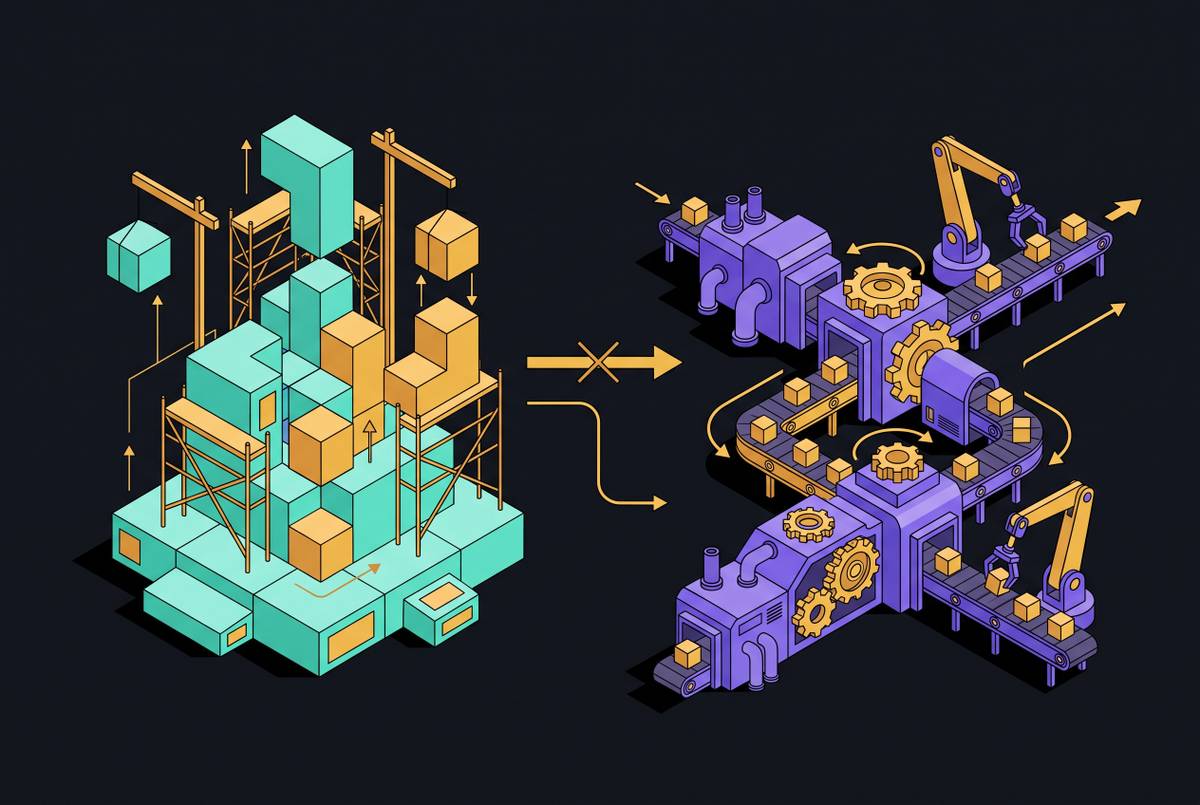
A buyer uses three systems to confirm stock, while a fulfillment team re-keys data that was already captured. These are specific breaks in how work gets done. Yet an enterprise AI rollout can treat both as general productivity problems without finding out why either workflow takes the extra effort. AI redesign means rebuilding the process around the point where it fails instead of adding an assistant to the steps already in place.
McKinsey’s June 2026 report on European retail finds that scaled AI still delivers uneven results, even as firms believe strongly in it and spend more on it. That gap makes targeting an operational priority. An inventory department with errors in its receipt data needs a different fix from a fulfillment department with problems in its delivery handoffs. Merchandising introduces another problem when stores execute the same promotion inconsistently. A platform-wide mandate does not, by itself, distinguish among those causes.
Enterprise platforms still offer consistency and infrastructure that teams can share. Those are useful foundations, but neither establishes whether a department’s process is sound. Standardizing access to AI cannot resolve an undefined handoff or make an inaccurate stock record reliable. Making broken processes work the same way can spread their flaws. The department is therefore the right unit of diagnosis, even when the technology supporting the eventual redesign is shared.
What process-first AI redesign actually requires before any agent is deployed
If backroom records are inaccurate, a forecasting agent is aimed downstream of the failure. The audit must first establish how stock is received, scanned, handled, and returned, rather than accept the intended procedure as a description of daily work. Actual work is the starting point. Operations leaders need the people doing it to show where records diverge from physical stock and where the workflow becomes inconsistent.
Research from Technical University of Munich and SAP Signavio in April 2026 finds that clear change descriptions from domain experts are essential to conversational process model redesign. When requests are vague, the model changes cannot be trusted even if the AI tooling works well. This makes process clarity a deployment requirement because an agent cannot reliably execute a process that the department cannot clearly describe.
Process intelligence serves that practical purpose by reconstructing actual workflows. It identifies both the point where AI could intervene and the work that must change first. Standardization must precede automation. Although an audit takes time, skipping it can produce an agent that follows its design correctly and still fails in production because the design describes a workflow that does not exist.
Inventory management: where the failure point is usually upstream of the forecast
Inventory errors often originate at receipt or during backroom handling, before a forecasting model receives its inputs. Dependable recorded inventory requires reliable receipt logs, backroom scans, and returns processing. When the underlying records are wrong, improving the forecasting algorithm leaves the department’s primary failure untouched.
McKinsey’s report identifies analytical AI, including demand forecasting, as a foundation already delivering measurable value. The argument is therefore not against forecasting technology. It is against using forecasting as the default explanation for an inventory problem. Before deploying an agent, the department must establish whether its inputs are accurate and consistently captured. Otherwise, automation scales the inaccuracy and produces wrong answers with greater speed and confidence than manual work.
Supply chain risk detection illustrates why even related inventory applications need separate diagnosis. Early warnings about supplier delays or disruptions along logistics routes depend on signals that differ from those used to maintain stock records. They need their own data instrumentation. A forecasting workflow and a disruption-warning workflow may inform related decisions, but they do not fail in the same way.
The redesign target follows from that distinction. Where intake records are unreliable, the first intervention belongs in intake. Where disruption signals are missing, the work concerns risk detection. Treating both as a general need for better forecasting obscures the process that actually requires repair.
Fulfillment: why coordination failure is the right problem to target, not routing speed
Fulfillment presents a different kind of breakdown. Dispatch, delivery, and customer communication can each perform their local tasks while the handoffs between them fail. Routing optimization does not resolve that gap. An agent that calculates a faster route can leave the team unable to coordinate a changed delivery window or resolve an exception.
Furniture delivery makes the distinction concrete because failed deliveries, long lead times, and elevated customer-service costs make coordination especially consequential. In that setting, failed handoffs can outweigh routing failures. Embedding agents in dispatch and customer communication therefore represents a different redesign target from improving route calculation alone. The unit of work is the coordinated delivery process, including what happens when the planned delivery cannot proceed.
That process needs clear decision rights before an agent acts. The department must define who can change a delivery window, who resolves a damaged-goods exception, and how the decision is logged. Otherwise, the agent may wait for approval that no one clearly owns or act beyond its sanctioned scope. Faster execution cannot compensate for ambiguous authority.
Coordination improvement is also measurable, despite the apparent simplicity of measuring routing speed. Customer-service cost and return rates are downstream outcomes of coordination quality. They give operations leaders a basis for evaluating whether a redesigned handoff improves fulfillment. The test should cover both how fast the agent does its own task and whether the delivery process leads to fewer costly exceptions.
Merchandising: why pricing and assortment AI fail when promotional execution is inconsistent
McKinsey’s report identifies commercial merchandising, including pricing, promotions, and assortment optimization, as likely to have the largest impact across retail. It also identifies softline retailers as likely to see the largest overall upside because assortment complexity and less predictable demand create substantial optimization potential. Complexity creates opportunity, but it also complicates interpretation. A model needs data that reflects what stores or retail partners actually executed.
When promotional execution varies, aggregate data can conceal whether a plan was weak or inconsistently implemented. That distinction is central to the next decision. A pricing or assortment agent may optimize a signal that does not reflect actual shelf conditions. Process intelligence is needed to expose those execution gaps and the fragmented data that obscures them.
Dynamic pricing also depends on inventory levels, seasonality, and competitive signals. Those inputs do not remove the need for dependable promotional and catalog infrastructure. AI-generated product content has a similar constraint. McKinsey’s report describes productivity gains from generative AI in marketing and content creation, but content can support the intended retail interaction only when it reflects the assortment actually available.
The redesign must start by making sure promotions run the same way and catalog data can be trusted. Pricing and assortment optimization agents follow that work. Reversing the order asks the analytical layer to compensate for uncertainty in execution, even though the model cannot safely treat the planned promotion as evidence of what happened on the shelf.
How Walmart's department-specific agent architecture illustrates the rebuild-by-department logic
Walmart’s internal merchandising tool Wally, launched in March 2025, targets identifiable work within the department. It connects to a semantic layer over internal data to automate data entry, analysis, root-cause investigation, and calculations previously handled manually by merchandising staff. The design addresses friction in the merchandising workflow instead of asking staff to find uses for an undifferentiated productivity assistant.
Walmart’s broader architecture also separates audiences and functions. Its July 2025 unveiling included Sparky for shoppers, a separate agent for in-store associates, Marty for suppliers, sellers, and advertisers, and a developer-facing agent. Those boundaries recognize differences in data, decision logic, and operating needs. A shared commitment to AI does not require every function to use the same assistant.
Walmart’s “Trend-to-Product” process provides another merchandising-specific outcome, with its timeline cut dramatically through generative AI and a redesigned workflow. Separately, AI-driven logistics optimization led to documented savings each year. These outcomes belong to different operational processes. They support a model in which each function has its own redesign target and its own evidence of value, rather than a single enterprise adoption measure standing in for operational results.
Walmart’s scale is exceptional, but scale is not the transferable principle. The lesson for other operators is to separate agents according to the work and failure modes they must address. An operator does not need the same breadth of deployment to diagnose manual friction and define a department-specific intervention.
What agentic AI in retail actually requires to move from pilot to production
McKinsey’s report describes agentic AI as the emerging next step, with systems acting more independently to handle decisions and tasks. It also notes uneven scaled results and a narrowing window between experimentation and obsolescence. That pressure does not eliminate the preparation requirement. A live retail operation exposes agents to dirty data, exceptions, and edge cases that a controlled pilot may never encounter.
Production reliability depends on data consistency, clear decision rights, and defined human oversight. Each resolves a different uncertainty. Consistent data gives the agent a dependable basis for action, while decision rights establish what it may decide. Human oversight defines where responsibility remains with people. Without those conditions, an agent can stall at precisely the point where the operation needs a decision, or proceed beyond the authority it was given.
Governance is therefore operational work. Guardrails must be planned before scaling begins so that the agent’s scope matches the process it enters. A successful small pilot still leaves those boundaries to be set. It shows value under the conditions tested, but the department still has to work out how the agent will handle exceptions in daily work.
Restrictions also need to fit how much an agent can do on its own. Over-restricting a simple agent slows delivery and encourages shadow workarounds, while under-restricting a more autonomous one creates operational and compliance risk. Neither problem is reliably exposed by a demonstration. Production preparation must address both the actions an agent should be allowed to take and the decisions that require human control.
How to identify which department process to redesign first
For operations leaders, the starting question is where the process hurts and whether the department can describe exactly how it runs today. That is more discriminating than asking where AI might help. A workflow that appears well suited to AI is not necessarily the workflow whose repair will produce the greatest value.
Prioritization should consider concentrated friction, error rates, and coordination cost together with data readiness and decision rights. Pain alone is not enough. The data feeding the process must be structured and accurate enough to support an agent, and its authority must be clear enough to define an operating scope. Evaluating impact, feasibility, data readiness, and reuse potential together makes the choice more disciplined than selecting a prominent use case.
This also limits the tendency to spread effort too thin. A department-specific intervention needs a sufficiently bounded process that the team can understand, rebuild, and put into use. The first redesigned process should be live in weeks. A longer timeline is a diagnostic signal that the wrong process was chosen or that its operation was not sufficiently understood before implementation began.
The process audit makes that selection defensible. Having someone demonstrate exactly how the work runs and where it hurts gives leaders field evidence about both the problem and the conditions for fixing it. An executive mandate or platform roadmap cannot supply that evidence. The highest-leverage decision comes before deployment, when the department identifies a process whose failure it can explain and whose redesign it can put into operation.