Rebuilding vs. Automating Existing Workflows
Automating a broken process just makes it fail faster.
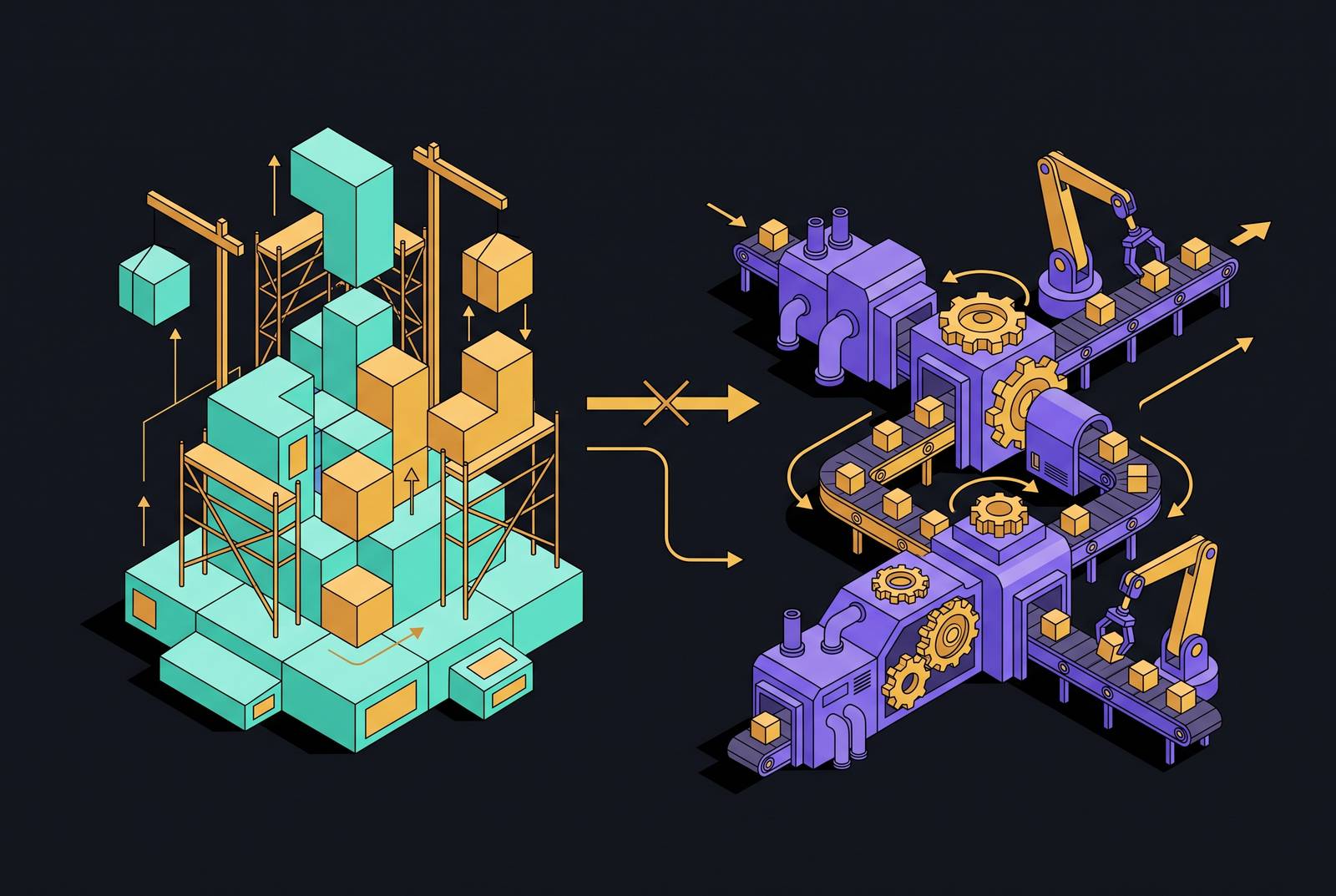
The choice between automating a workflow and rebuilding it is really a question about whether the current process deserves to exist at all. Most organizations never ask that question. They buy the automation layer first, then discover that the flaws they hoped to eliminate are still there, only faster now, and harder to reverse.
Why automation amplifies broken processes instead of fixing them
A three-way match process that fails because purchase order data is missing will produce the same failures once automated. The automation removes friction from the failure, not from the flaw that causes it. Automation is a force multiplier, and force multipliers are indifferent to whether what they amplify is good or bad.
Most enterprise AI programs treat this as a risk to manage after deployment rather than a design question to settle before it. The distinction that matters is between first-order and second-order effects. First-order gains arrive as tasks running faster and cheaper, which is what most automation delivers. Second-order effects change how work is structured: maintenance shifts from fixed schedules to predictive models, and quality control moves from catching defects post-production to identifying precursor process conditions. These are categorically different outcomes, and most programs capture only the first while the second goes unaddressed. This distinction between first-order and second-order effects is where most enterprise AI programs go wrong. They capture task acceleration without redesigning the workflow structure around it, and firms like Terminal Use, which start by auditing the process as it actually runs, surface whether the flaw lives in execution or design before automation locks it in place. Deloitte AI Institute's 2026 research found that 48 percent of organizations have introduced AI without redesigning the workflows or roles it sits within, while only twelve percent report redesign at scale with a new operating model behind it.
Why so many organizations automate anyway, and why it feels rational in the moment
The impulse to automate existing workflows rather than redesign them is not irrational. It is a predictable response to real constraints, and it deserves to be understood before it is criticized. Redesign carries organizational risk: it requires admitting that the current process is wrong, reassigning ownership, and absorbing temporary disruption while the new structure takes hold. Automation, by contrast, can be scoped, budgeted, and sold to stakeholders as an incremental improvement. It looks like a bounded project with a defined endpoint. Redesign looks like an open-ended transformation with no guaranteed finish line. Short evaluation cycles reward speed of deployment over quality of process design, and teams that ship automation fast look like they are executing. An automated broken process runs fine for weeks or months before the amplified flaw surfaces at scale.
In asset-heavy, process-intensive industries, this pressure is especially acute because the operational stakes make any disruption feel dangerous. Construction, logistics, and manufacturing teams are often running live projects under contractual obligation, and stopping to redesign feels like it creates more risk than it removes. That fear is real, but the risk of amplifying a broken process at scale is larger and harder to reverse. Operations firms that move to rebuild see their first process live in weeks because they are not managing two versions of the workflow simultaneously, which is what automation-first approaches require. The construction sector illustrates the trap clearly. The root cause stays intact.
What a process audit actually reveals about where workflows break
The decision to rebuild or automate cannot be made honestly without first documenting how the process actually runs, not how it is supposed to run. Process compliance rarely fails because policies are missing. It fails when policies stay disconnected from daily execution, leaving tasks unassigned, controls unverified, and evidence scattered across systems. The evidence that makes field reality legible is specific and unglamorous: cycle times, exception logs, SLA breaches, ownership gaps, and manual overrides. This is where the actual process lives, not in the documented version that sits in a policy manual.
The most important findings in a process audit are the workarounds, because workarounds are the process's own diagnosis of where its design fails. Every manual override, every spreadsheet that runs alongside the system of record, every email chain that substitutes for a formal handoff is evidence that the designed process cannot handle a real condition it regularly encounters. These are the highest-value redesign targets: the points where a person is manually connecting two systems or translating data between teams. A rigorous process audit documents these deviations before any redesign choice is made, which is why operations rebuilders typically begin there rather than with a technology roadmap. Terminal Use's process audit approach starts precisely here: clients show exactly how a process runs today and where it hurts before any decision is made about what to rebuild.
The signals that indicate a process is worth rebuilding rather than automating
Rebuilding is warranted when the process's failures are structural, rooted in how work is sequenced, owned, and handed off, rather than in execution speed or data volume. Structural failures include steps that exist because the process was designed around a constraint that no longer applies, unnecessary human checkpoints because the system of record cannot surface the right information at the right time, and parallel workstreams running sequentially because no coordination mechanism exists. Execution failures are different. These are tasks that are well-designed but slow because they are repetitive, data-entry-heavy, or dependent on information that can be retrieved automatically. Automation can legitimately address execution failures. The diagnostic question for any process is simple: if this process ran twice as fast, would the outcome be twice as good, or would the same failures arrive twice as fast?
Three operational patterns consistently signal that a process needs rebuilding rather than automation. The first is sequential handoffs where humans serve as digital glue, manually connecting two systems or translating data between teams. The second is local optimization that destroys network-level performance, where each function optimizes its own output while no one optimizes across the whole. Demand planning, inventory, and logistics running in parallel silos connected only by periodic manual reconciliation is the classic form. The third pattern is declared state diverging from field state. Schedules and plans look correct on paper but have already been invalidated by conditions in procurement, supplier lead times, or site readiness that no one has surfaced yet. This pattern is particularly dangerous because it is invisible to the people running the process. They are working from the declared state, not the field state, and automating this pattern makes the divergence harder to detect, not easier.
How the declared-vs-field-state gap plays out in mission-critical construction
The U.S. data center buildout is the clearest current illustration of what happens when declared schedules and procurement plans outrun physical supply-chain reality. Transformer lead times have stretched dramatically, from roughly two years before 2020 to as long as five years, which means procurement decisions made today determine energization windows years out, not months. A large share of planned 2026 U.S. data center capacity has been delayed or canceled as a result. The physical constraint was visible in procurement data long before it appeared in project schedules, and the organizations that saw it coming were the ones watching procurement rather than trusting the declared timeline.
The operational structure here is the same one that produces failure in any mission-critical project: what is declared diverges silently from what is happening in the field until a hard constraint forces the reckoning. Construction schedules must align civil work, structural installation, and equipment energization with precision, and delays in any one package can stall commissioning across the entire facility. Automating the schedule-reporting layer without fixing the underlying data flows between procurement, fabrication, and site does not close the gap. It makes the gap look tidy while it grows. An AI agent that monitors fabrication status, flags equipment lead-time exposure against the commissioning window, and surfaces misalignment before the schedule absorbs it is doing something categorically different from one that generates faster Gantt chart updates. The second merely documents it more efficiently.
What genuine process rebuilding looks like in practice, with named examples
The cases where AI delivers measurable operational gains share a common structure: the workflow was redesigned before, or as, the AI was deployed, not after. Toyota's logistics visibility work is a clear example. The company deployed an agentic tool to give staff real-time vehicle estimated time of arrival visibility from pre-manufacturing through dealership delivery, a process that previously required navigating between 50 to 100 mainframe screens with significant hands-on work. The agent now delivers that information directly without anyone touching the mainframe. The gain is not speed on the old process. It is the elimination of the coordination layer the old process required. Procter & Gamble's supply chain redesign follows the same pattern. The company streamlined 35 processes down to 20 through OMP's Unison Planning, a touchless, AI-enabled planning platform currently handling 80 percent of planning touchlessly, with a path to 100 percent. It simultaneously created new roles that did not exist before: supply flow analyst and supply flow engineer. The redesign changed both the process architecture and the organizational structure around it at the same time.
The structural pattern across these cases is consistent. The process was redesigned to allow AI to operate with genuine agency across a sequence of tasks, not to assist humans performing the same sequence as before. In each case, the gain comes from eliminating the coordination cost between steps, the review, validation, and adjustment that occurs every time work passes from AI to human, rather than from making individual steps faster. This is what task chaining means in practice: AI handles a sequence end to end, which removes friction that individual-step automation leaves in place. The cases also disprove the objection that this requires massive upfront investment. Targeted redesign of a specific, painful process can compress timelines dramatically. Terminal Use's approach fits this pattern: the first AI-first process goes live in weeks, not quarters, because the starting point is a specific painful process identified through the audit, not a broad platform strategy. The right sequence is audit first, identify the highest-pain structural break, rebuild that process with AI agents inside the workflow rather than bolted on as a reporting layer, and get it live before expanding scope.
Where manufacturing and logistics operations face the same structural break
In manufacturing and logistics, the same pattern produces the same outcome: AI deployed inside a structurally broken process optimizes the wrong thing. Traditional logistics planning moves linearly from forecast to inventory plan to transport schedule to execution, while each function optimizes locally and no one optimizes across the network. AI layered onto this structure makes each local optimization faster without resolving the coordination failures between them. In manufacturing, AI adoption is strongest where process signals are rich and outcomes are measurable, in quality and production, and weakest where coordination across functions is required. Deloitte's 2026 manufacturing research documents this uneven distribution across the value chain. The pattern that unlocks second-order gains is the same one that worked in the construction cases: running parallel processes concurrently with AI coordinating dependencies in real time, rather than sequentially with humans managing handoffs.
Supply chain resilience illustrates why workflow structure matters more than model capability. The structural break is the same across construction, manufacturing, and logistics. The question is always whether the process is worth keeping at all, and the answer is found in how work actually flows, not in how the model performs.
How to start: the process audit as the entry point to rebuilding
The right entry point to any AI-first transformation is not a platform selection or a roadmap. It is a specific, painful process examined honestly. The process audit is not a consulting deliverable that precedes the real work. It is the mechanism that determines whether a process should be rebuilt at all, and if so, which one first. It surfaces cycle times, exception logs, SLA breaches, ownership gaps, and manual overrides. This is the evidence of how the process actually runs, not how it is documented.
The criteria for the first process to rebuild are four. High pain means the team is already working around it, which means the process has already diagnosed its own failure. Clear ownership means one team or one department runs it end to end. Cross-functional processes are worth rebuilding eventually, but they are not the right first process. Measurable outcome means the team can tell within weeks whether the rebuilt process is performing, not months of instrumentation before signal appears. And the structural flaw must be one that automation would amplify rather than resolve. Terminal Use's approach is built around this starting point: a process audit that shows where a specific process hurts today, followed by a rebuild with AI agents inside the workflow, and a live first process within weeks, not quarters. If a firm cannot articulate what is wrong with the current process before proposing a solution, that is itself a signal worth heeding.