AI-First Workflow Design Patterns for Asset-Heavy Industries
Connect decision-making to execution, not just task speed.
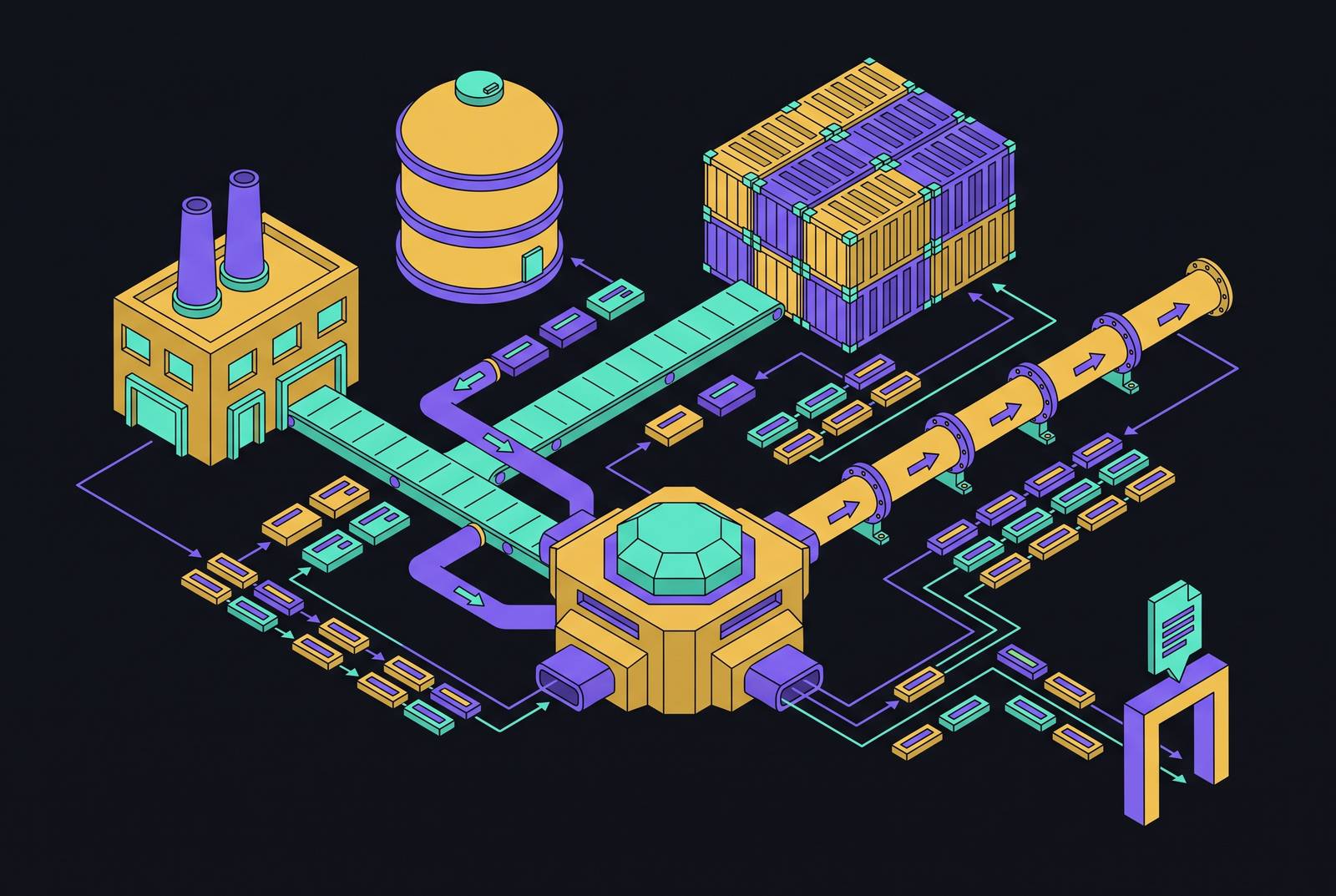
AI-first workflow design in asset-heavy industries produces durable gains when it changes how work is sequenced and handed off. The effective pattern places agents inside execution, gives them bounded authority, and preserves human judgment at defined checkpoints. Its starting point is a specific, painful process whose bottlenecks are understood before the technology is selected.
Why task automation in asset-heavy industries keeps disappointing
A construction schedule can look achievable while a procurement delay has already undermined the sequence it describes. Faster daily logs do not resolve that contradiction. Nor does reviewing documents faster, on its own, change what happens in the field. When automation improves those tasks without changing their handoffs, it accelerates parts of a process whose central constraint remains intact.
Construction, logistics, manufacturing, and retail share this vulnerability because work moves through long, cross-functional chains. A delay in one step cascades downstream. Task-level savings are therefore absorbed by the time spent waiting for another team to interpret information, make a decision, or execute it. Even one step that AI cannot handle can hold back the whole operation. The distinction is between completing an activity faster and changing the logic that connects it to the next activity.
What "AI-first" actually means at the workflow level
An execution-layer agent detects a condition, evaluates alternatives against constraint rules, and acts within a bounded authority envelope. A reporting-layer tool stops before that final step. It alerts a person who must then translate the information into a correction elsewhere. AI-first design closes this decision-to-execution gap, where a known condition remains unresolved while the operational consequences accumulate.
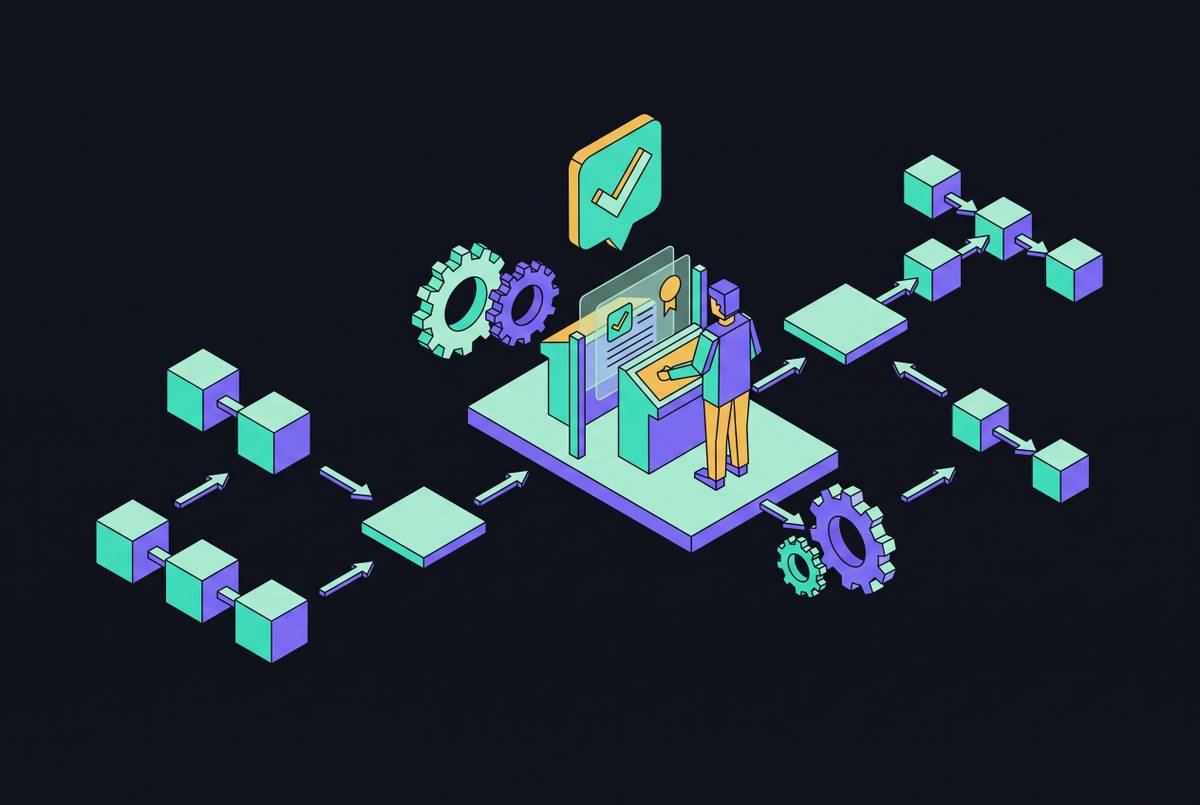
The workflow still has checkpoints where people use their judgment. Those checkpoints distinguish it from a simple pipeline. An agent can perform a repeating sequence of decisions and actions while asking a person to resolve ambiguity at a defined point. This is the concrete purpose of agentic architecture in multi-step, cross-system work where conditions vary and exceptions overwhelm legacy automation.
However, the ability to complete that sequence in a demonstration does not establish production readiness. Deployment needs access control and identity integration, monitoring and incident handling, scaling that works as expected, and a support model with a clear owner. It also needs a release process and rollback path. Without these, the gap between demo and production remains open even when the agent performs its assigned task well.
Why the process audit must come before the pattern
Begin by identifying the actual bottleneck. Three recurring forms are documentation drag, late risk visibility, and cross-project pattern blindness. Status updates may take so long that they are written inconsistently. Elsewhere, risks are identified late because nobody can regularly read the underlying project material, or systemic problems recur because no one examines them across the portfolio. Each points to a different redesign target.
The audit must also expose how decisions are made. Exception ownership, data-quality performance, process standardization, decision rights, escalation thresholds, human escalation paths, and audit logging are readiness gates. They cannot be deferred until deployment. Process mining can help locate delays and rework, but the design also depends on making visible the complexity that experienced staff have absorbed over years.
A specific, painful process gives this investigation a workable boundary. A platform strategy does not provide that boundary. Starting narrowly makes it possible to connect a diagnosed problem to a live result rather than spend quarters designing around assumptions. Without the audit, teams select patterns for the process they think they have.
The graduated autonomy pattern and how it structures human-agent handoffs
Graduated autonomy defines authority by decision type. A procurement agent can reorder materials within a spending cap but escalate above it. A logistics agent can reroute within a geographic region but needs approval for changes across borders. A maintenance agent can adjust soft parameters but never hard safety limits.
The envelope is a deliberate design choice. It can widen as reliability is demonstrated. Within it, an immutable audit trail makes each action traceable to the triggering condition, the alternatives evaluated, and the constraint rule applied. At its checkpoints, the “elicit” primitive asks a human to reduce ambiguity.
Escalation is exception-driven: the agent handles large numbers of routine cases while people make the decisions that need their judgment. This division makes broader autonomy possible without treating every operational choice as equally safe or equally consequential.
How the pattern applies in construction: sequencing, procurement, and energization risk
Construction schedules describe intended work, but field evidence tests whether that work remains achievable. Vision-based progress verification tracks completed work against the plan and issues end-of-day deviation alerts. The alert is still a reporting-layer output. The execution-layer shift occurs when agents use changed conditions to resequence dependent tasks and notify affected trades, an approach a handful of firms are piloting when deliveries slip.
Procurement is a particularly good place to make that shift. Field Materials is developing AI-driven procurement software covering quote scanning, purchase order creation, invoice processing, and inventory management. Linking those activities helps close the gap between a change in design and the response in the field. The redesign therefore concerns the chain of decisions.
Energization readiness calls for more than schedule documents alone. An AI-analyzed construction project identified failure to obtain a use permit by a hard funding deadline as its most critical execution risk. It also identified live transformer relocation and demolition sequencing as a high-consequence, high-risk operational task. Such dependencies require attention beyond declared dates.
Suffolk and MIT’s September 2026 white paper used a sample multifamily project to model the effects of six AI-enabled levers. Cutting the most time from the schedule took all six together. Individual levers produced more limited, phase-specific savings, supporting the case for connected workflow redesign.
How the pattern applies in logistics: closing the exception ownership gap
A logistics exception is not resolved simply because it has been detected. Someone must own the response and its outcome. That distinction becomes especially important when exception volumes are high, response expectations are short, and delay has an immediate cost. An execution-layer agent closes the gap only if its authority and the ownership of an incorrect action are established before deployment.
Freight audit shows the value of a well-defined workflow. AI audit systems catch invoice errors before payment and, in some workflows, shorten dispute cycles from months to same-week resolution. One manufacturer converted contract terms into routing-guide logic and audited accessorials, reaching $516,000 in annualized LTL savings. The operational result depends on applying the terms within the payment and dispute process.
Unilever uses AI-analyzed weather inputs to improve volume forecasts so that production lines can be adjusted when the weather changes how much people consume. This is AI-assisted, human-in-the-loop coordination. Interface risk testing, data-quality performance, and exception ownership establish whether a deployment can support real operations.
How the pattern applies in manufacturing: agentic coordination across production and maintenance
Deloitte’s 2026 Manufacturing Industry Outlook describes where executives want to invest across smart manufacturing, with agentic AI starting to draw interest. Investment priority is not production deployment, however. The design must connect asset condition data to the production and maintenance decisions that depend on it through an agent. Predictive-maintenance reporting can narrow that gap without closing it.
A recommendation still leaves a person to arrange the work. In the execution-layer version, the agent schedules the maintenance window, coordinates parts availability, and notifies affected production lines within its authority. A condition detected in asset monitoring can then propagate into production scheduling, parts procurement, and workforce allocation without a separate manual translation between systems.
The authority envelope follows the physical consequences of action. It can allow scheduling, sequencing, and parts ordering within a cap, while keeping hard safety limits out of reach. Separating permissible coordination from prohibited intervention answers the objection that autonomous maintenance is inherently too risky. The boundary can begin conservatively and widen as demonstrated reliability supports it.
How the pattern applies in retail: rewriting the operational logic of department workflows
Retail makes the phased, department-level redesign pattern particularly clear. The first phase targets high-friction, low-strategic-value work, commonly including product descriptions, SKU categorization, and standard content production in ecommerce. Yet automating them becomes workflow redesign only when the department changes its old decision logic to organize the work around machine capabilities.
The department audit therefore precedes the choice of tasks. Volume alone is a poor proxy for friction. Leaders need to identify where staff time is consumed, errors compound, and escalation paths break down. That evidence determines which legacy methods to discard and which judgment points to preserve.
The same logic extends to inventory, pricing, and fulfillment across physical and digital channels. Their decisions must remain consistent across systems. As in logistics and manufacturing, the execution-layer pattern addresses the lag between recognizing a condition and putting a coordinated response into effect. Each phase produces a live result that validates the redesign before it extends further. The first process should be live in weeks, making delivery time a test of scope and pattern choice.
The four conditions that determine whether an AI-first redesign holds in production
The first condition is process standardization before autonomy. Agents cannot work reliably when decision rules are unwritten and vary from case to case. Documented decision rights, defined exception thresholds, and specified escalation paths make the workflow legible enough to execute. Without that foundation, apparent agent failures may begin in unresolved process ambiguity.
The second condition is data quality treated as an operating constraint. Poor or unavailable data undermines the decisions built on it. In procurement and construction, drawings, quantities, and supplier data must be structured and current before agents act. Cleaning them up after deployment begins leaves the execution layer dependent on inputs that are not ready.
The third condition is exception ownership assigned in advance. Accountability cannot begin with the first incident. When an agent acts incorrectly, a named owner must already be responsible for the outcome. Leaving that assignment unresolved makes the first significant exception a threat to confidence in the entire deployment.
The fourth condition is a release process with a rollback path. Monitoring, incident handling, and the ability to revert an agent’s action distinguish production operations from a demo running in production. These are operating commitments. Skills gaps cannot compensate for an illegible workflow, and additional expertise does not resolve missing decision rights. The process audit brings all four conditions together by showing what must be settled before agents can act on their own.
How to sequence the first AI-first process redesign
For an operations leader beginning this work, the first step is to select the single most painful process in a specific department and surface how it actually runs. Informal workarounds belong in that account. The objective is a visible decision sequence, including the complexity that experienced staff manage without written instructions.
The second step is to locate the decision-to-execution gap. In that gap, a known condition waits for a response. That may be procurement-to-field propagation in construction, exception resolution in logistics, condition monitoring to maintenance scheduling in manufacturing, or cross-channel consistency in retail.
The third step is to define the graduated autonomy envelope. Permitted actions, required escalations, and ownership of escalated decisions must be explicit. These are process design choices. The fourth step is to put process standardization, data quality, exception ownership, and plans for release and rollback in place before go-live.
The fifth step is to measure completion by testing the intended end-to-end output. Strong performance by an isolated AI component does not establish that the redesigned workflow works.
An operational transformation partner fits this task when its starting point is a process audit. Its role is to determine what to rebuild from how the work runs and where it hurts. The first live deployment should follow in weeks. If it requires quarters, the scope is wrong, so the next action is to shrink it, demonstrate completion, and then extend the pattern to adjacent workflows.