AI Agent Architecture for Enterprise Operations Workflows
Start with one painful process, then build observability before expanding autonomy.
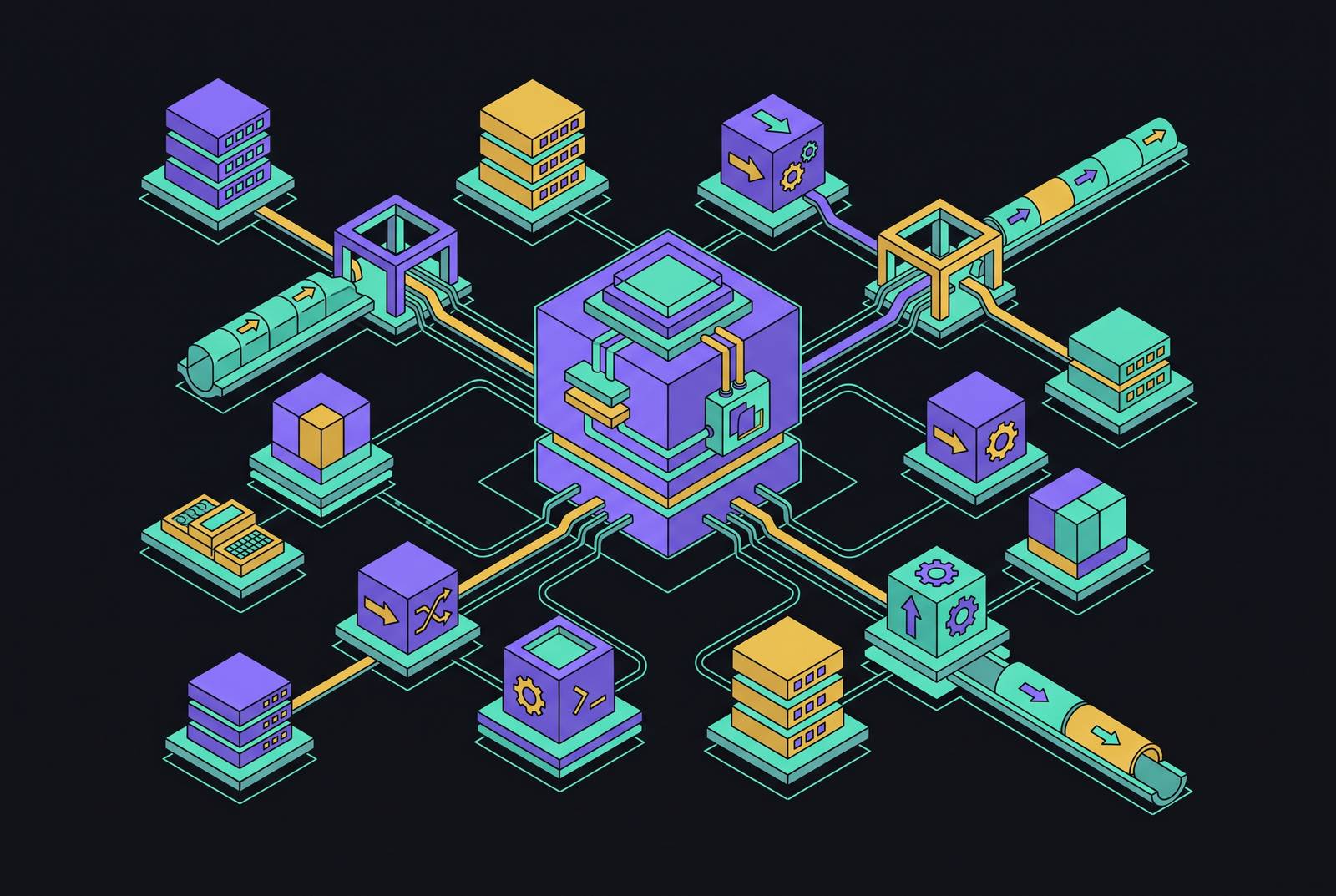
AI agent architecture for enterprise operations workflows does not require a platform strategy before work can begin. Work can begin with one painful, measurable process, supported by five interdependent layers, namely Intelligence, Decision, Execution, Action, and Learned. Integration and observability must be production-ready before autonomy expands, because an effective Learned layer uses operational evidence to improve the system, while an ineffective one lets failures accumulate unseen.
Why most enterprise AI agents stall between demo and production
The pilot worked, stakeholders approved the budget, and production stalled. Clean data and a narrow scope had demonstrated that the agent could perform a task, but not that the organization could depend on it. Live operations exposed accumulated ERP configurations, inconsistent APIs, and disconnected data. Questions about approval authority and responsibility for errors then became deployment blockers.
An agent layered onto a broken workflow can leave its defects in place and accelerate them. Teams that begin with the workflow instead map its decision points and consider how the process would differ if designed for an agent. That distinction changes both the work assigned to the system and the controls surrounding it.
Architecture makes these problems easier to locate. Treating deployment as a single decision conflates faulty reasoning, failed integration, unauthorized action, and undetected drift. Each requires a different investment, even when the visible symptom is simply an unreliable result. The five layers provide a diagnostic lens for separating those failures rather than treating the whole agent as one malfunctioning component.
What an enterprise AI agent actually is, and what it is not
An enterprise AI agent plans, acts, and iterates toward an objective across a multi-step workflow with minimal supervision. It does more than produce an answer. Chatbots respond to prompts, copilots support individual tasks, RPA bots follow deterministic scripts, and basic LLM APIs generate text. The operational distinction is between assistance and action, because an agent can retrieve context, form structured decisions, update records, trigger downstream processes, and escalate exceptions.
Enterprise use adds constraints that conversational fluency cannot satisfy. An agent must operate on approved internal data, respect permissions and workflow state, and act through governed integrations. Unlike a consumer-facing interaction, a procurement or scheduling decision can change what happens in an operation. Mistakes can propagate beyond the original task. Field-level access controls, workflow versioning, reasoning traces, and encoded escalation paths therefore deserve more scrutiny than interface design or ready-made templates.
The five-layer architecture and what each layer actually does
Intelligence is the LLM foundation for reasoning across the stack. In asset-heavy operations, it must handle structured and semi-structured inputs, including schedules, procurement records, and sensor outputs. A strong model without retrieval can hallucinate enterprise-specific information, while a weaker model with well-structured retrieval can outperform it on operational tasks. The foundation depends on the context supplied above it.
Decision handles planning, goal decomposition, and retrieval-augmented reasoning. It determines which information is needed and how work should be divided into ordered steps. In construction scheduling, this means tracing a steel delivery delay through dependent activities on the critical path and considering fast-track recovery options. In multi-agent systems, it also assigns subtasks to downstream agents, establishing the coordination logic before orchestration begins.
Execution connects the agent to enterprise tools and systems. In manufacturing, those connections include ERP, MES, and logistics routing systems, while construction adds scheduling platforms, procurement tracking, and vision-based progress systems. The layer must support the actual configurations and schemas in use. Its quality determines whether the agent is embedded in the workflow or remains outside it.
Action orchestrates agents, workflows, and approval gates. Where Decision determines the division of work, Action governs the sequence of handoffs and the conditions for human escalation. A demand-forecasting agent, a vendor-coordination agent, and a logistics-routing agent may each perform a specialized role. Their handoffs still require explicit operational controls. Approval gates and escalation paths belong in the running system, because informal conventions cannot constrain autonomous state changes.
Learned combines persistent memory, observability, and improvement from operational feedback. Memory keeps context across sessions and past decisions, while observability ensures that the steps that matter are logged and can be replayed. Together, they connect outputs to their operational consequences. This layer allows decisions to be traced, audited, and used to improve the system. It is also under-invested in most often, despite being necessary to distinguish reliable performance from silent degradation.
Where each layer breaks in practice, and what the failure looks like operationally
Intelligence failure produces plausible outputs that are wrong for the operating context, particularly when grounding is weak. A domain expert may discover the error only by comparing the result with live procurement or scheduling data. Decision failure can be harder to isolate. The agent may carry out every subtask correctly while working toward the wrong goal or breaking the goal into the wrong steps. Successful steps then conceal a failed outcome.
Execution fails when integrations that worked in the pilot meet production load or live data schemas. In construction, procurement fields that differ can keep the agent from reaching the records it needs to reason about the schedule. Action fails when orchestration has no firm boundaries. Signs include choosing the wrong environment or account, agent decisions that clash, infinite loops, and unauthorized state changes. Insecure inter-agent communication can also allow compromised or misconfigured instructions to pass downstream.
Learned failure is less visible than a broken API. Stale risk scores or outdated routing decisions can continue influencing operations without an audit trail that exposes the drift. The error does not remain in a chat window. In manufacturing supply chains or construction readiness work, wrong outputs can affect purchase orders, material movements, or commissioning. Missing observability delays discovery until downstream decisions have already been made.
Paper governance describes controls that have no connection to the running system, while retrofitted evidence attempts to reconstruct decisions after months of operation. A control is operational only when it has a location in code, an artifact, and a named owner. For the Learned layer, that means meaningful steps logged from deployment, decisions traceable to model version and data state, and deviation alerts within the workflow.
How the layers compose: why the Learned layer is the one that determines scale
Good reasoning with poor integration leads to decisions based on flawed data, and good decisions with weak Action controls can break policy. At one company, AI-only deployments brought small gains in efficiency, while changing the business as a whole took digital, operational, and human layers working at the same time. No single capability produced the whole outcome.
The Learned layer has a distinct role within that dependency. A system can launch with capable reasoning, integration, and orchestration, then drift as data, schemas, and operating conditions change. Without memory and observability, that drift remains difficult to detect or explain. With them, failures in other layers become visible early enough for targeted correction. Learned supplies the evidence needed to maintain those layers.
Construction procurement makes the distinction concrete. A scheduling agent may repeatedly flag an unresolved conflict or stop flagging conflicts after an ERP schema change. Without observability, either behavior can go on until it affects field work. In manufacturing, replayable purchase-order decisions serve a related purpose. They allow human planners to see when autonomous adjustments approach the edges of the guardrails they set, rather than discovering those pressures through operational disruption.
Action coordinates the handoffs, but shared memory and observability reveal whether those handoffs produce cascading errors. Separate records of tasks that seem to have succeeded do not show success if the workflow as a whole misses its goal. The Learned layer connects local behavior to system performance. That is why adding agents without improving the evidence loop expands activity without establishing that coordination is improving.
What sector-specific deployments reveal about which layers break first
Construction exposes the Execution layer first because scheduling, procurement, ERP, and vision-based progress systems rarely share a common schema. An agent can understand CPM logic and float analysis yet fail to trace a steel delay because lead time fields differ between systems. The integration blocks otherwise useful reasoning. Production uses in 2026 remain narrow, including RFI drafting, first-pass submittal review, tender analysis, daily logs, and schedule risk detection. Pilots that re-sequence tasks and notify trades do not yet establish agent control of core delivery workflows.
Manufacturing puts the Action layer under pressure at scale. Agents that adjust purchase orders, production schedules, and logistics routing within defined parameters need clear limits on who can approve what. Those limits apply both to live production and to compliance records. Deloitte's 2026 manufacturing survey found that Quality leads AI adoption at 62 percent and that adoption is strongest in Quality, Production, and Logistics/Supply Chain. These operational settings make the consequences of poorly governed action especially direct.
Logistics exposes Decision-layer problems before orchestration can resolve them. Demand forecasting, vendor coordination, and routing depend on agents decomposing their goals coherently with one another. Conflicting plans can emerge before any action executes. The sector therefore makes workflow redesign particularly important, because agents supporting disruption response and real-time decisions depend on a process designed for that coordination. Faster execution cannot reconcile incompatible objectives.
Retail and CPG expose Learned-layer weaknesses in closed-loop replenishment. Shelf scanning, automated ordering, and dynamic labor scheduling depend on a history of decisions and deviations to avoid oscillating between over- and under-ordering. Stable demand can hide the weakness temporarily. When demand shifts, a stateless agent lacks the feedback needed to improve its response. Employees also need to understand how to work with the system, so operational evidence must support human intervention.
How to fix one broken plant process without buying a whole platform
For operations leaders, a process audit comes before a platform selection exercise. The operation should show how the process runs today, where it hurts, and which decisions create the difficulty. Suitability comes before autonomy or integration design. Koch and Wellbrock's integration framework places use case suitability first, followed by decisions covering autonomy, technical integration, governance, security, employee enablement, and measurable impact. A repetitive, clearly scoped, measurable process provides a stronger entry point than a demonstration chosen for its apparent sophistication.
Workflow redesign should then define the agent's actual role. Controlled partial autonomy is the right model for now. Human planners set guardrails while agents work within defined parameters, so people stay responsible. That gives the first deployment a bounded objective without requiring full autonomy or an enterprise software strategy.
Within that scope, Execution and Learned must be ready for production before Decision and Action take on more work. Live integrations establish whether the system can work with the operation's actual data, while observability establishes whether its performance can be judged. Governance belongs in the same first investment. Code-level controls, named owners, and audit artifacts are harder to retrofit after incidents than to build into deployment. A constrained, configurable path preserves custom development for processes where deeper architectural requirements make it necessary.
A first process that takes quarters to reach production is a diagnostic signal. It usually points to an unsuitable starting process, omitted redesign, or an Execution layer being built against data that is not ready. Live-in-weeks is therefore a signal about approach. The first live process begins the evidence base for further investment, showing which decisions remain difficult, which integrations need work, and where operating boundaries need adjustment. That evidence makes the next architectural commitment defensible without making a platform roadmap the prerequisite for improvement.