What a Pre-AI Process Review Actually Looks Like for Logistics and Construction Operators
Operators must fix broken workflows before deploying AI agents into them.
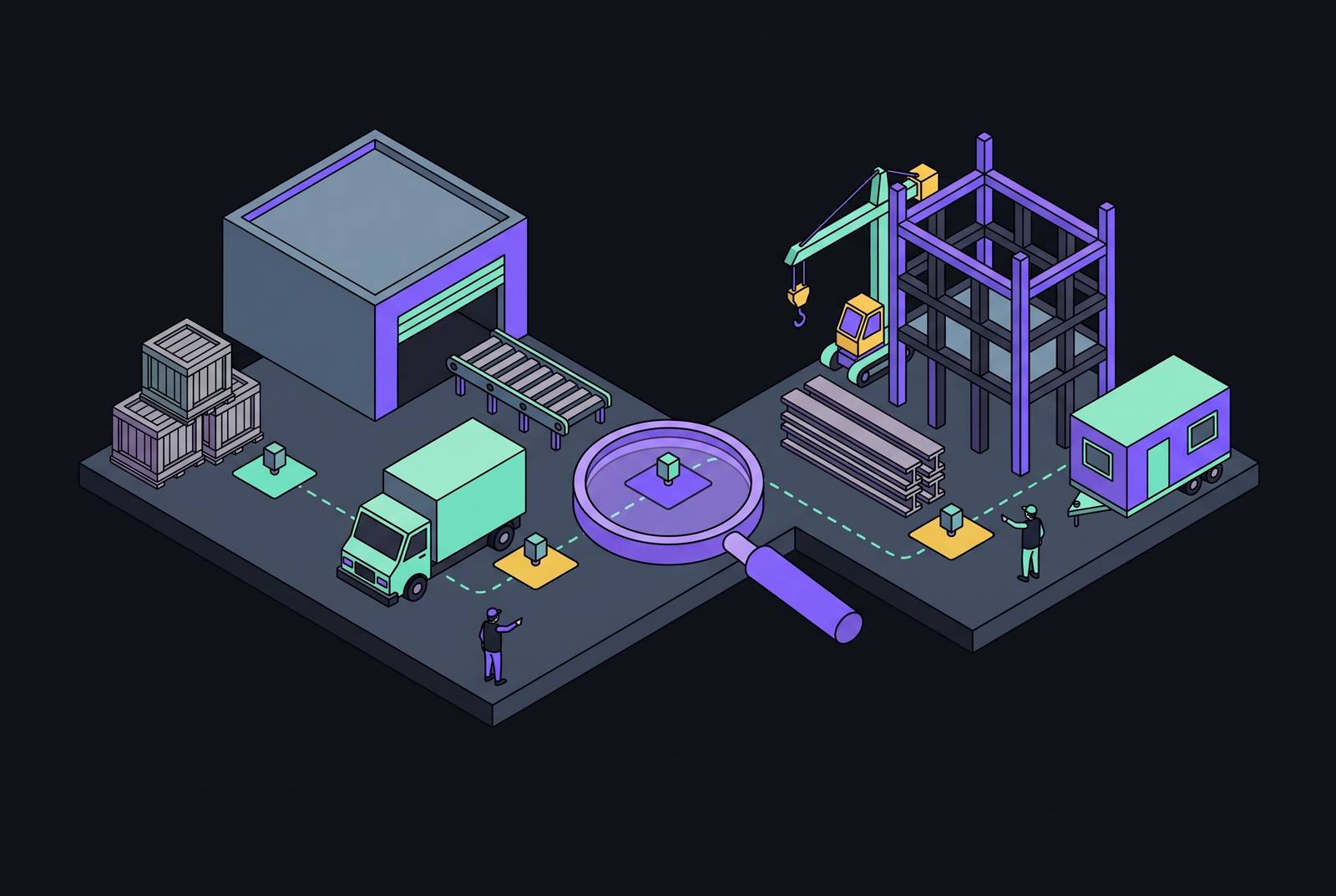
A pre-AI process review for logistics and construction operators investigates how one workflow actually runs, where its decisions fail, and what must change before an AI agent can operate reliably inside it. It draws on practitioner interviews, watching the work firsthand, and the system records available. Its purpose is not to select software, but to produce a redesigned workflow fit for deployment.
Why logistics and construction operators need a process review before any AI deployment
An AI agent can follow an official process correctly and still fail the operation. In logistics, enterprise software implementations are frequently designed around corporate process manuals, while daily work depends on informal practices those manuals omit. An agent introduced into that environment follows documented procedures that omit steps people actually perform. The missing step may be an informal override or a constraint exception that nobody wrote down.
Construction presents the same underlying problem through different workflows. A declared schedule can appear orderly while procurement commitments, approval windows, and commissioning status make it unachievable. Faster processing does not repair that mismatch. Capable technology applied to an unsupported process produces faster failure. The investigation therefore belongs before deployment.
What a pre-AI process review is and is not
A pre-AI process review must establish what operational changes deployment requires. Nor is it a conference-room mapping session that converts an org chart into a diagram. Workshops that produce descriptions without changing how work happens leave the central deployment question unanswered.
The review is a bottom-up investigation of the gap between declared and actual operations. Its working structure is deliberately simple, comprising an analyst, a structured interview program, a template, defined time with representative people in each role, and system telemetry where available. Observation grounds the interviews in actual work. The transformation lead must report to the C-suite rather than IT so that operational findings reach leadership without being filtered through a technology-only view. The resulting decision concerns what to rebuild first.
Step one — how do operators choose which workflow to audit before AI deployment?
The review must choose what to examine before writing it down because it cannot cover everything. The first candidate must happen often, have a measurable baseline and known pain, and be small enough to redesign within weeks. A process that happens often is part of the ongoing work of the operation. A baseline such as cycle time, error rate, rework volume, or hours consumed makes improvement testable. Known pain anchors the investigation in problems practitioners can describe without prompting.
A painful process without clear boundaries can absorb the review without yielding a deployable workflow, while an easily measured process may address an inconsequential gap. Selection is therefore not a vote. The loudest complaint does not necessarily identify the decision failure with the greatest operational consequence.
In construction, candidates include document search and scope review in preconstruction, RFI and submittal coordination, change order tracking, and energization readiness sequencing. In logistics, similar places to start include shipment documentation processing, in-transit status management, and visibility into procurement status across suppliers. Each still needs to be checked against the selection criteria. Beginning with a platform strategy reverses that order and risks producing broad coverage without a practical change.
Step two — documenting how the process actually runs today, not how it is supposed to run
Once the process is selected, the investigation follows the people doing the work. At each role, it records the actual sequence of actions, including workarounds, informal shortcuts, and decisions made outside any system. Waiting and searching are part of that sequence. So is asking another person for an answer the system cannot provide. The interview also establishes what the practitioner would have done differently if better information had been available at that moment.
For construction document search and scope review, the baseline includes the hours spent finding information and the rework that could have been avoided if requirements had not been missed. It also records how often junior staff review full documents without supervision. For RFI and submittal coordination, cycle time alone is not enough because resubmissions and missing context explain why another review is needed. Change order tracking requires a different trace, following whether a shared record establishes what changed, when, at what cost, and with whose approval.
In logistics procurement, the investigation follows engineers and procurement staff as they request quotes, confirm pricing, validate lead times, and check material availability across suppliers. The review looks for what is missing from the central view of those exchanges. In-transit and replenishment work requires attention to informal overrides, undocumented constraint exceptions, and data that nobody retrieves consistently. Logs, timestamps, and approval records add to these accounts. They cannot replace observation because an informal workaround may leave no system trace.
Step three — identifying where decisions actually break down
The completed map becomes useful when it identifies why a decision degrades. Information unavailability means the decision-maker cannot see what is needed because it sits elsewhere or was never captured. Decision latency means the information is there but takes too long to get, so work goes ahead without it or waits until the cost rises. Invisible exceptions expose a different weakness altogether. The standard case works, but an unusual case has no defined route and is handled informally without a record.
In construction energization, the breakdown may originate upstream in capital approval and reach facilities as a deadline attached to a timeline the grid operator does not recognize. Missing a submittal approval window can cost a factory slot as well as delay a task. Long switchgear lead times make that loss unrecoverable through overtime or re-sequencing. P6 schedules capture intent. Procurement data, coordination records, and commissioning status show whether the work can happen in the planned order.
Keentelen Engineering’s field testing case makes the consequences concrete. Integrated systems commissioning surfaced fourteen additional discrepancies involving control logic, alarm mapping, and a generator sequencing fault, all closed before handover. Occupancy began three weeks after the original date. The assessment was that the uncorrected fault had a high probability of causing a full facility outage within the first year.
Manufacturing and logistics face a distinct fragmentation problem when agents cannot see across ERP, MES, quality, and logistics systems. A partial view can support a confident but wrong answer. At each breakdown, the review must distinguish a process that needs repair before AI from one where AI can supply the missing capability. Those findings require different responses, even when both initially look like information problems.
Step four — assessing whether the process is ready for an AI agent to operate inside it
Readiness is a judgment about a particular workflow. The assessment must identify where an agent would produce reliable output today and where it would act from partial or inaccurate information. Centralized documents alone do not establish readiness. Coordination can remain fully manual even when files share a location, leaving the process standardization gap untouched.
The assessment first examines data availability and consistency, including whether the agent can access usable information from the systems that hold it. It then examines decision boundedness, establishing which decisions fall within scope and which exceptions require escalation. Workflow standardization asks whether instances follow a consistent enough pattern for past examples to support reliable performance. If every instance runs differently, the review must expose that variation.
Auditability matters just as much, especially in construction disputes and safety incidents. The team must be able to reconstruct why an AI-assisted decision was made months later. KPMG’s Q4 2025 AI Pulse Survey found that 75% of large-enterprise leaders cite security, compliance, and auditability as the most critical requirements for agent deployment. The reconstruction requirement therefore belongs in readiness assessment.
The objection is that readiness can become indefinite delay. An assessment with a clear scope avoids that delay by naming the prerequisites to meet and keeping the work from becoming an improvement program with no end. For controlled draft support, those prerequisites include a defined source set, output format, reviewer, and prohibited assumptions. Those parameters should be settled before use, with the first process kept small enough to go live within weeks.
Step five — redesigning the workflow so an AI agent can operate inside it reliably
Redesign starts from what the workflow should be if it were built for an agent, rather than which existing actions software could reproduce. The review has established where the present sequence fails, so the design can change the sequence itself. This is not simply faster execution of existing steps. Suffolk and MIT’s white paper, modeled against a completed $180M project, found that AI creates serious value when several workflows change with it, rather than when it is added to workflows that remain unchanged.
Within the selected process, the design defines which steps the agent handles and where human judgment takes over. It identifies the data sources and resolves relevant gaps or inconsistencies before go-live. Informal exceptions get clear escalation paths so that handling them no longer depends on whoever happens to spot them. An audit trail gives the team a way to reconstruct AI-assisted decisions. These are operating requirements.
RFI coordination illustrates the change in responsibility. Instead of a human triggering each step, an agent-driven workflow can draft, cross-reference drawings and specifications, route, monitor, and follow up, with defined human handoffs. Even where the selected workflow touches others, the review does not become an enterprise redesign. Its scope remains the process actually examined.
What operators should expect the review to take, cost, and produce
A bounded review covers one process end to end across the roles that touch it. The work includes structured practitioner interviews, observation, and review of available system telemetry. Its written assessment sets out where decisions break down, how the workflow must run for an agent to work reliably, and what must change before deployment. Leadership descriptions provide context but cannot substitute for practitioner evidence.
The expected duration is weeks. A longer program indicates that scope has expanded or that the engagement has become a consulting project. Cost cannot be reduced to a defensible fixed figure from the information available here. The practical basis for sizing the work is the defined analyst effort, interview time per representative role, observation, and telemetry review.
The deliverable extends beyond a written report. Completion means a redesigned workflow with a defined first AI process ready to go live once its prerequisites are met. Enterprise-wide assessments, platform strategy sessions, and multi-month discovery programs are signs that the review itself has become the project. A report left in a folder does not meet the operating objective.
The person leading the work needs direct operational experience in construction or logistics. A generalist technology consultant is not a substitute for that domain knowledge because the decisive failures appear in operational details, including approval windows, supplier commitments, and commissioning dependencies. The analyst must recognize which details change the decision. Otherwise, the review can record exactly what happens and still miss why it fails.
Why skipping the review produces the failure patterns already visible across the industry
Jacobs research published October 2026 found that only one in five U.S. energy-sector respondents says their organization consistently delivers major infrastructure projects on time and budget. That finding comes amid a structural gap between the data center power capacity that has been announced and what is actually being built. It describes a delivery problem that faster information processing alone cannot resolve.
The failures examined in the review explain how premature certainty develops. Fragmented systems then give an agent only part of the picture.
In the commissioning case, scenario testing found defects in systems that had seemed ready, so they could be fixed before operations began. A pre-AI review applies that investigative discipline to the workflow before an agent begins making or supporting decisions inside it.
Skipping the review can turn apparent deployment speed into a failed pilot, a shelved project, and greater skepticism among the people expected to use AI. Operators who complete it have a different starting point. They have a bounded process, explicit decision rules, and a workflow designed for production. That is the basis for reaching live operation within weeks of completing the review.