Pre-Automation Audit Checklist for Logistics Operations Leaders
A four-part audit shows which workflows are ready to automate.
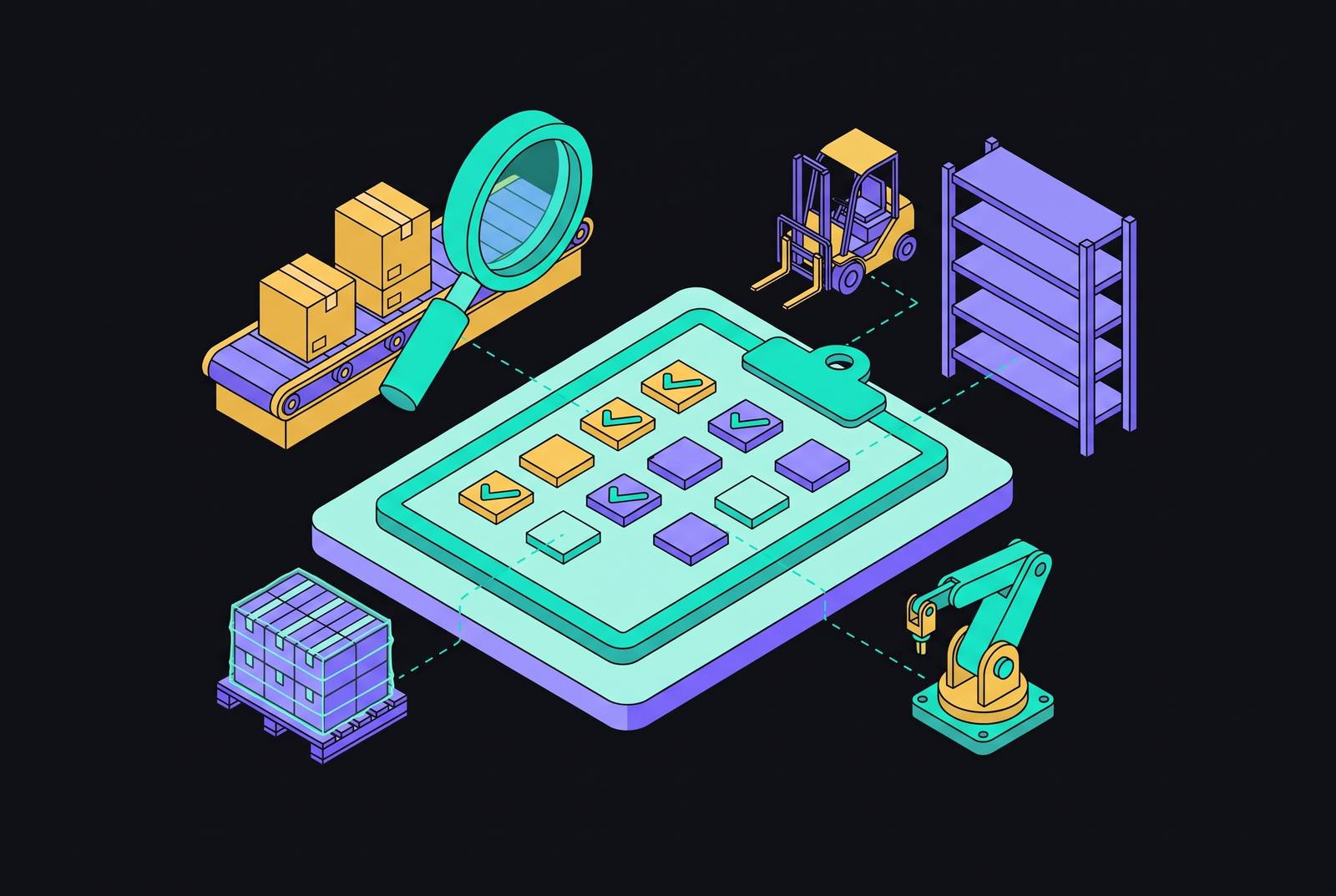
Before deploying AI in construction or logistics operations, leaders need to audit data quality, workflow logic, exception handling, and human ownership for each target process. This pre-automation audit checklist explains how to find those gaps and decide which workflows are ready. The central requirement is process health because automation accelerates the damage when the underlying process is broken.
Why logistics automation projects fail before they begin
A logistics operation automates a workflow, but the delays, discrepancies, and workarounds remain. The tool executes faster without correcting the process it inherited. A documented carrier selection policy may omit the exception that dispatchers resolve manually every day. Automating that policy removes the workaround without resolving the reason it exists.
Uber Freight CTO Val Marchevsky argues that the biggest opportunities come from using AI to redesign broken processes for efficiency. Agentic AI raises the stakes further. These systems can reason and act without a human starting them, so a flawed rule can guide decisions about the work without a human checkpoint. The audit must therefore establish whether the underlying process is sound before the organization gives a system authority to execute it.
What should a logistics company audit beyond technology before implementing AI?
A technology assessment evaluates integration compatibility, API flexibility, and system interoperability. It establishes what tools an operation can run. A pre-automation audit asks whether the process should run in its current form at all. These exercises address different questions, and a successful IT readiness review does not establish operational readiness. Integration can connect systems while leaving conflicting records, undocumented decisions, and unassigned work untouched.
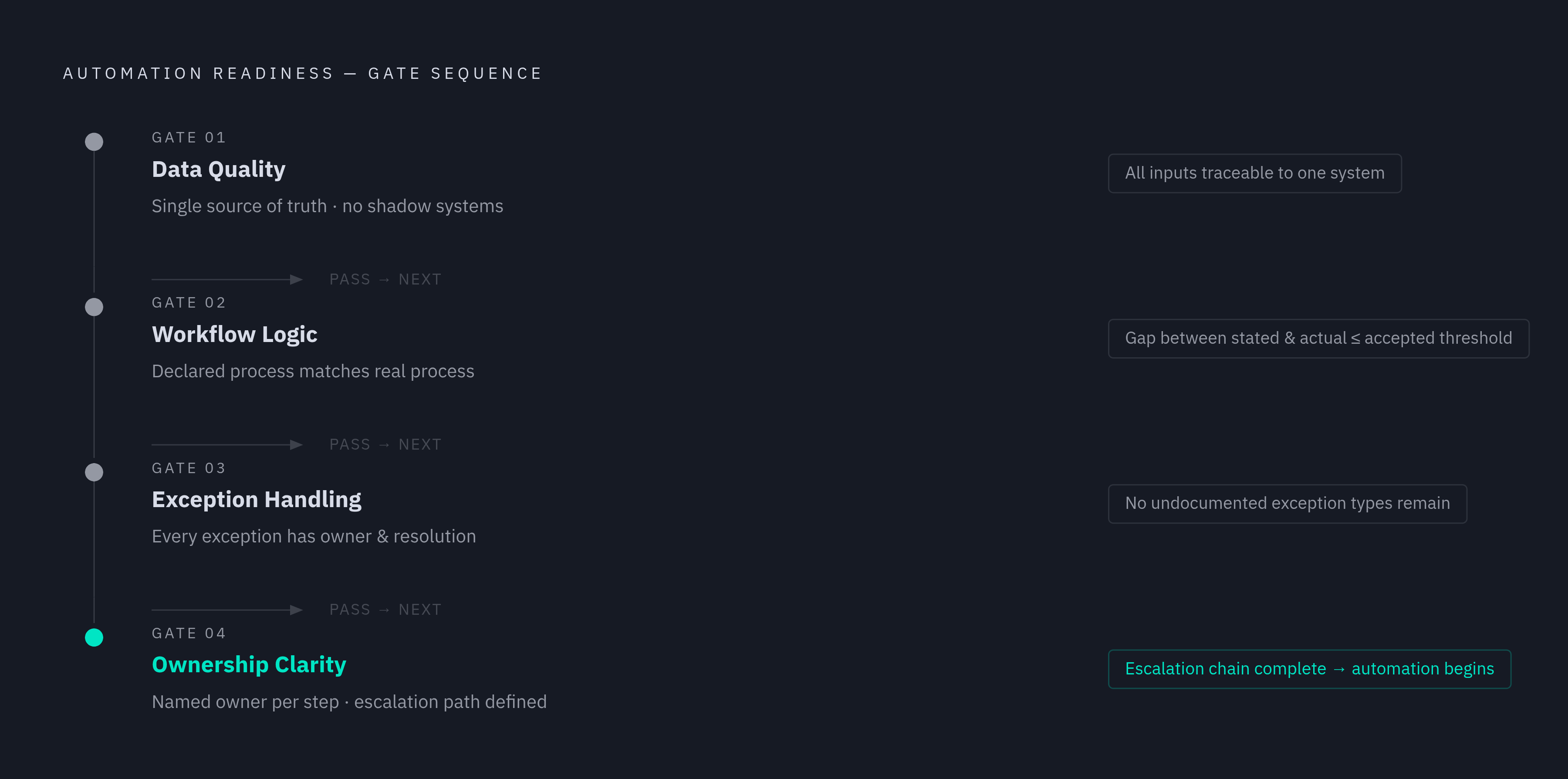
The audit examines four dimensions, namely data quality, workflow logic, exception handling, and ownership clarity. Each dimension must show what is happening in a specific workflow. A finding such as “poor data quality” is too general to support a deployment decision unless it identifies the affected process, the missing or conflicting inputs, and the accountable owner. The same requirement applies to workflow gaps. The audit must show where execution departs from the intended process and what must change before automation begins.
The starting point should therefore be a specific operational pain. Automating a warehouse is too broad a brief. Auditing the invoice reconciliation step that holds up carrier payment for four days defines a process whose inputs, decisions, and ownership can be examined. That narrower framing also gives the technology assessment a useful purpose. It can evaluate whether a tool supports the corrected workflow rather than allowing the tool’s capabilities to define the project.
Data quality as the hard prerequisite that most audits skip
Data verification is the first gate. Route optimization requires delivery locations, vehicle constraints, traffic conditions, and historical travel-time data, while AI-powered WMS requires picking, inventory, labor, and order data. Predictive supply chain applications need historical sales data, inventory levels, supplier lead times, and other signals from within and outside the operation. Possessing substantial operational data does not establish that the target process has the inputs it needs.
The audit should identify those inputs and establish whether they exist in a single, accessible system or an external spreadsheet. Completeness and historical depth need separate examination. Route optimization and predictive ETA tools require enough historical lane performance data to identify patterns. Freight invoice audit has a different dependency, including carrier rate confirmations, accessorial documentation, carrier invoices, bills of lading, and proof of delivery. The test is whether the available records can support the specific decision being automated.
A single source of truth in the TMS is a prerequisite because conflicting records can produce authoritative-looking but incorrect outputs. The audit should establish whether carrier performance, GPS, invoice, and inventory data is reconciled in one place before automation reads it. Unresolved shadow systems are a readiness failure. Any target process that still depends on an external spreadsheet or manual extract should remain outside automation until that dependency is resolved. Otherwise, the project starts with missing information that faster processing cannot fill in.
How the declared process and the real process diverge — and how to surface the gap
Reliable inputs do not establish that the workflow using them is sound. The declared process describes how work should happen, while the real process reflects what people do when conditions depart from that description. The gap often reflects the structure of the workflow. Workers respond to the immediate situation, and steps expected by an auditor or downstream system can be skipped when the workflow does not display them at the point of execution. A process document cannot establish whether those steps actually occur.
Freight tendering makes the distinction concrete. A dispatcher’s actual carrier selection logic may differ from the documented policy because the policy does not account for a common exception. Automating the documented version can then route loads differently from the way dispatchers do. The discrepancy becomes visible when carriers receive unexpected tender sequences. What appeared to be a manual inefficiency was also an undocumented decision rule.
To surface that gap, the audit should follow the person doing the work through each step, including workarounds. Frontline workers can describe how the work gets done in ways that process documents cannot. Every point where they consult a separate system, tool, or file exposes a dependency the automation may miss. The walkthrough should also establish where evidence is captured and where it is absent. If a step is not logged when it occurs, automation will have no record of that execution either, leaving the audit unable to distinguish the intended workflow from the one actually performed.
Exception handling as the stress test most checklists ignore
The workflow walkthrough becomes most revealing when normal conditions stop applying. Cases in which a carrier declines, a document arrives late, or an invoice does not match the rate confirmation reveal decisions made through informal routines. They also expose whether the process defines a resolution or merely moves the problem elsewhere. A system that performs well on the happy path has not yet demonstrated that it can handle the work around it.
Freight invoice audit illustrates the necessary precision. AI can identify rate mismatches, unapproved accessorials, and duplicate charges, but those categories require operational definitions. The audit must establish what constitutes an approved accessorial, what documentation validates detention, and what threshold triggers human review. Undefined exceptions can pass through without being flagged. The result can be silent quality degradation, in which the system appears productive until someone examines its outputs.
The audit should document each exception type, its current resolution, the decision-maker, the information used, and the location of the decision record. Phone calls, Slack messages, and manual overrides deserve particular attention when they leave no system record. Those decisions are invisible to the automated workflow. Before deployment, the process must define what the agent may resolve autonomously, what requires escalation, and what distinguishes resolution from deferral. Controlled testing should cover those paths because results from the normal path alone do not show how the system will handle them.
Agentic AI makes these definitions operational policy. An agent that monitors capacity, flags coverage risks, and manages exceptions without waiting for human initiation acts on the rules it receives. Auditing those rules only after deployment can disrupt live operations.
Ownership clarity — the human accountability layer automation cannot replace
Even a correctly identified exception can remain unresolved when nobody owns the outcome. An AI-generated carrier performance flag may sit in a queue, or an invoice discrepancy may reach AP without anyone having the right to dispute it. Detection is not the same as resolution. Automation can remove repetitive work, but it cannot assign human accountability. The audit must make that assignment before deployment without relying on dashboard use.
For every automated process step, including exception paths, the audit should name the person accountable for the result. Monitoring alone does not constitute ownership. The escalation path must specify the triggering signal, the required response time, and what happens if no response arrives. The automation itself also needs assigned responsibility for output monitoring, exception queue review, and the authority to pause or override it. These are distinct responsibilities even when a single person holds more than one.
Oversight must also reflect the agent’s degree of autonomy. Uniform controls can over-restrict low-stakes agents while leaving high-stakes decisions insufficiently supervised. Gartner predicts that 40% of enterprises will demote or decommission autonomous AI agents by 2027 because of governance mis-calibration. For the audit, the practical implication is to align authority and oversight before launch. Where AI outputs influence customs filings, carrier approvals, or freight billing disputes, that work must include clarifying liability exposure before operational reliance begins.
How to sequence the audit — which processes to assess first and why
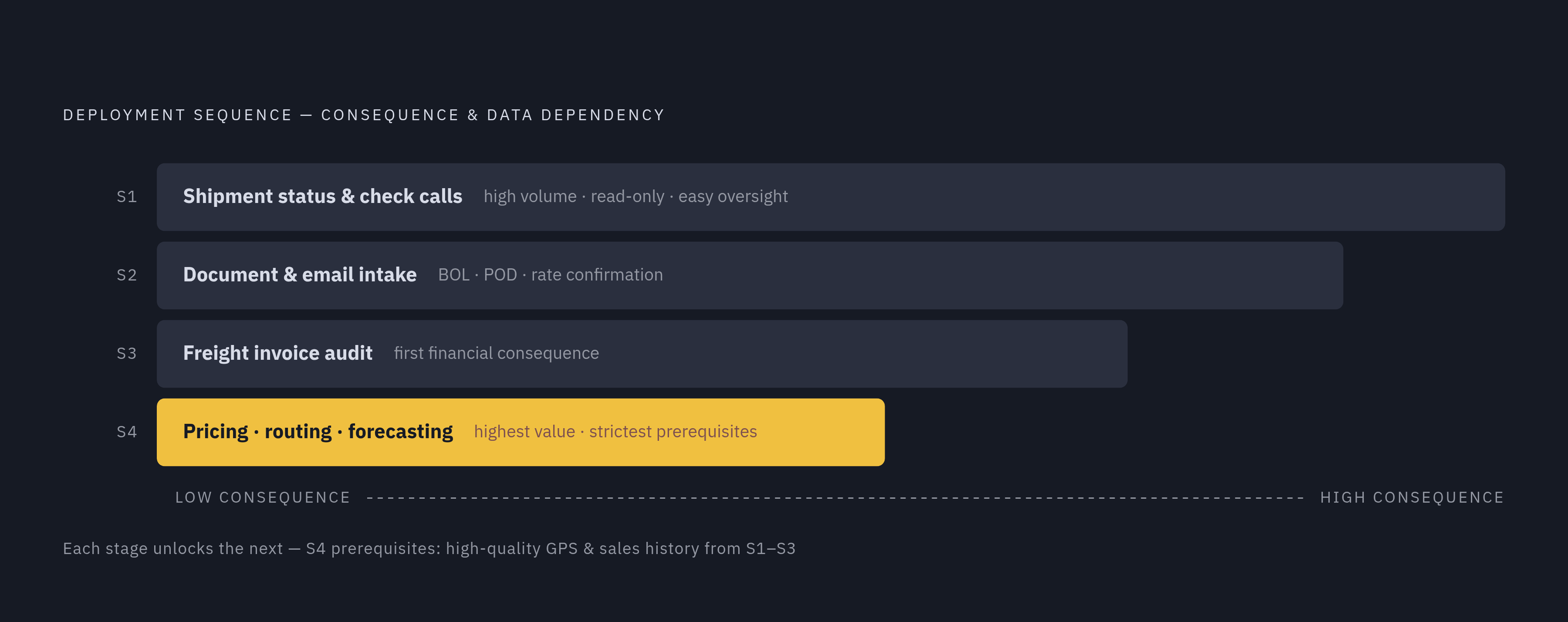
The audit should begin where operational impact and data readiness intersect. High-volume, read-only work is the best place to start when the data is already there, exceptions are defined, and people can easily oversee it. Shipment status updates and check calls fit that profile for most freight operations, which is also the kind of narrow, painful process where firms such as Terminal Use, an AI-first department rebuild partner whose embedded engineers first look at how a process actually runs today, tend to begin. Their limited scope makes it easier to check whether they are ready. It also keeps the first deployment away from decisions that directly influence pricing, carrier approval, or contractual commitments.
Document and email intake follows because it supplies information needed downstream. BOL processing, POD logging, and rate confirmation matching strengthen the foundation for more consequential workflows. Freight invoice audit is the first financially consequential step. It requires the data foundation and exception logic established in the earlier stages, rather than merely access to an invoice-processing tool. Intelligent Audit shows this need in its freight auditing, which finds billing errors and recurring cost patterns by linking transportation data across invoices, carriers, services, and shipping locations.
Pricing, routing, and forecasting should wait until the simpler layers are proven in production. High potential value does not remove data prerequisites. Route optimization needs high-quality historical GPS data along with the other inputs it uses, while demand-driven inventory positioning needs high-quality historical sales data. Deploying either without establishing those foundations risks failure and damages operator trust. The audit must precede each expansion because every additional process introduces its own dependencies, decision rules, and ownership questions.
In practice, leaders should select a bounded process, assess it across the four dimensions, resolve its gaps, and establish stable operation before advancing. Intake quality supports later audit work, and tested exception rules support more consequential decisions. A broad transformation cannot substitute for those foundations. A narrow, well-audited first process is the stronger starting point than a broad, under-audited transformation.
The pre-automation audit as an ongoing function, not a one-time gate
After deployment, the audit shifts from checking readiness to looking for drift. A live agent can appear to be working while its output quality deteriorates, with the effects reaching carrier relationships, invoice disputes, and customer delivery commitments before anyone notices. Activity is not proof of sound performance. Without a structured review, the operation cannot reliably tell whether an agent is doing good work on its own or repeating a process that has become flawed.
The ongoing audit should retain the same four dimensions used before launch. Data quality, workflow logic, exception handling, and ownership remain the operational standard as the system changes. Model version changes can degrade previously stable behavior. Periodic re-verification must therefore check that the process still works as designed after system updates. This requires visibility into decisions.
Every automated process should produce a traceable record of the data it read, the logic it applied, and the exceptions it routed to humans. That evidence allows review without interrupting operations. Leaders must also establish whether they have the people, process, and visibility to catch failures before they compound. If not, that gap is the first process to fix. Operations that build auditing as a continuing function can expand automation safely, while those that treat it as a gate passed once leave later failures without a reliable means of detection.