What Auditors Actually Examine When They Walk a Freight Terminal or Jobsite Before an AI Deployment
Pre-deployment site walks reveal where real operations depart from the documented process.
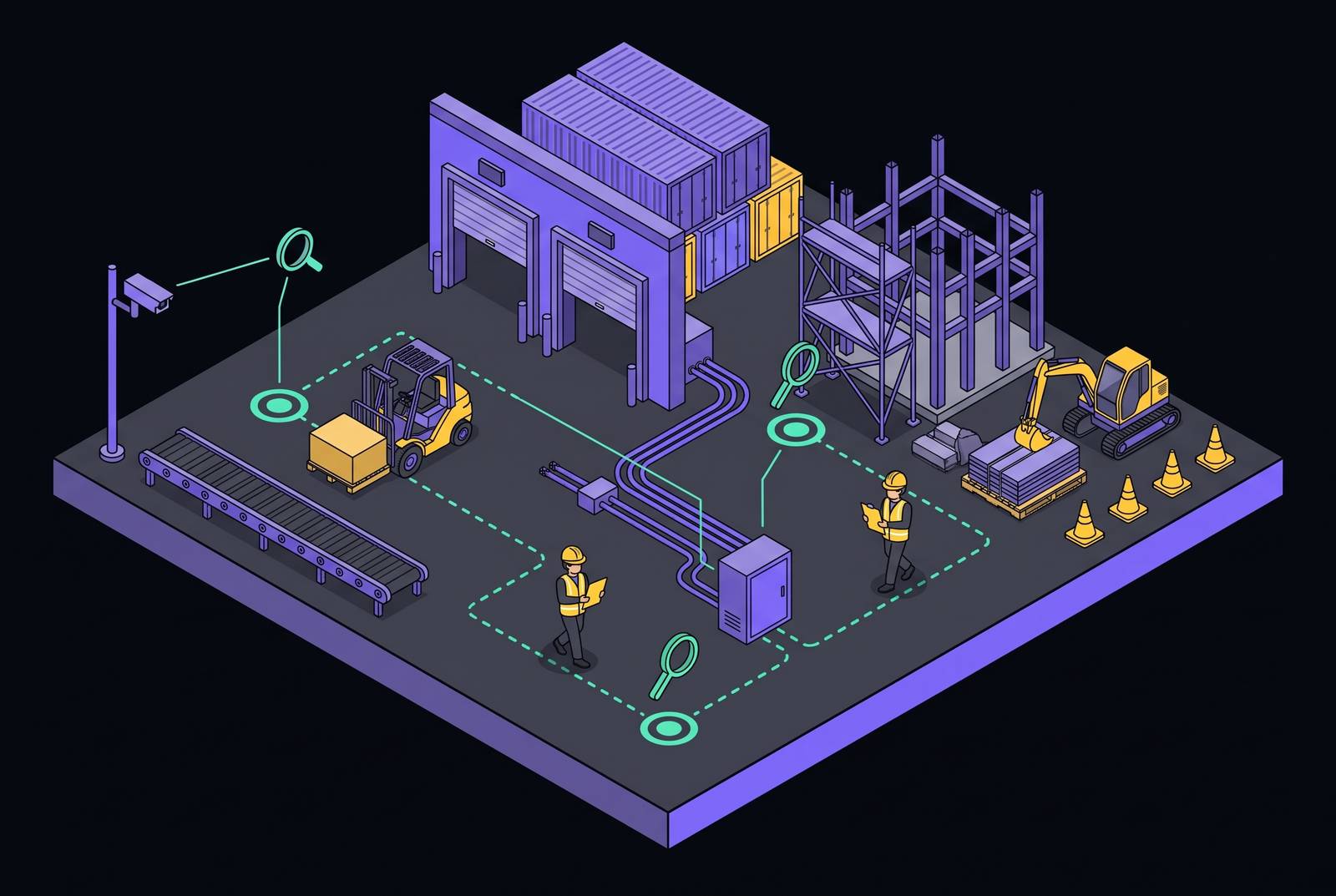
A process audit before AI deployment in construction and logistics examines the work the system will actually enter. Auditors walk freight terminals and jobsites to trace data, hand-offs, exceptions, decision rights, and physical constraints. The purpose is to expose and resolve the gap between declared and actual operations before an agent accelerates it.
Why the gap between AI ambition and operational reality keeps widening
A dock supervisor resolves an exception through an informal call while the system still shows the standard workflow. On a jobsite, work in the field moves ahead before the daily log reaches the people who manage the schedule. These are the conditions into which AI is being introduced. The gap between ambition and readiness begins when deployment plans assume that recorded work and actual work are the same. As agents make more decisions, it gets harder to rely on that assumption.
Technology presence is a poor proxy for workflow integration. An organization can have demand forecasting software running and still identify forecasting as one of its weakest areas. Across freight, construction, and manufacturing, layering an agent onto a broken or undocumented process can accelerate dysfunction. Val Marchevsky, CTO of Uber Freight, states that the biggest opportunities will not come from layering AI onto broken processes, emphasizing operational rigor and standardization as the foundation.
Some teams argue that a fast pilot exposes these gaps more efficiently than an upfront audit. That argument assumes teams can learn from a failed pilot at little cost. But when a pilot fails inside a broken process, it can leave people wary and make it harder to get money and staff for the next attempt. The pre-deployment walk addresses that risk by examining the operating conditions before they become reasons to reject the technology.
What should a logistics or construction company audit before implementing AI?
The purpose of a pre-deployment walk is to discover where the declared process diverges from the actual one. It is not a vendor-demo validation exercise. The org chart, SOP binder, and project timeline describe the declared process, while field crews, dock supervisors, and procurement coordinators reveal how work proceeds when the system does not cooperate. Their workarounds, tribal knowledge, and informal escalation paths are part of the operation the agent will enter.
A dashboard can show recorded activity without revealing the conversation that made a decision possible or the workaround that kept work moving. By being there, an auditor can follow those decisions and find the broken hand-offs. The walk is therefore diagnostic rather than evaluative. Its output is a true-state map.
The workflow comes before the agent’s proposed capabilities. Mapping each decision point makes it possible to ask what that workflow would look like if built from scratch for an agent. Without that examination, the deployment risks automating the declared process while leaving the actual process untouched. The audit establishes what would have to change for the proposed design to work.
Data infrastructure: the first thing auditors verify on the ground
Data is the first gate because an agent cannot reliably act on information that is absent, incomplete, or late. An auditor examines whether the required data exists, flows in real time, and is clean enough to support action. A systems diagram cannot establish those conditions by itself. At a freight terminal, the starting point is the flow between TMS, WMS, and ERP systems. FreightSuite’s deployment guide identifies auditing data infrastructure, including mapping those flows, as the first step before deploying a single agent.
On a jobsite, the equivalent examination tests the consistency of the records used to describe work. Auditors look for standard cost codes across projects and a single master schedule that is maintained. They also examine whether RFI and submittal timestamps are clean and whether change events connect back to the work breakdown structure. These are operational checks. The presence of a field or record does not establish that it provides a dependable account of the work.
Progress updates, daily logs, and field inputs may exist in the system but arrive hours or days after the events they describe. A real-time agent reasoning from those inputs would be working from an outdated picture. Auditors therefore trace a transaction from origin to close rather than stopping at confirmation that the systems contain data. Following that transaction can also uncover duplicate or incomplete records whose errors add up across a larger portfolio, even when a review of the systems looks satisfactory.
Process hand-offs and exception handling: where the walk gets uncomfortable
Once auditors establish how data flows, they examine how people use it to move work forward. The questions concern who hands work to whom, what information travels with it, what gets lost, and whether the receiving party can proceed without calling back. A record may be complete when reviewed afterward yet have arrived too late to support the decision it was meant to inform.
On a jobsite, a late progress update can cause a missed hand-off. If the update reaches the receiving team too late for them to act, putting it into the system later does not fix the missed hand-off. The data exists, but its operational value has changed. That is why auditors examine the timing and use of information, rather than treating a completed record as proof that the process worked.
Exceptions reveal even more than the standard path. A dock supervisor’s long-standing workaround, a coordinator’s call before logging a delay, or a problem fixed below the ticketing threshold can all be left out of the documented workflow. Auditors follow what triggers escalation, who decides, how long it takes, and what is recorded afterward. In a modeled dock cycle, throughput drops sharply when exceptions take up a large share of the elapsed time.
Manufacturing presents the same divergence when a process change reaches the floor weeks before its documentation catches up. Tribal knowledge fills the gap, quality slips, and audits become reactive. Exposing such differences can make a site walk uncomfortable, but the finding is diagnostic. It identifies the knowledge and judgment that an agent would otherwise be expected to operate without.
Process ownership and decision rights: the governance question the walk must answer
Once the exception path is visible, the next question is who owns the decision. The concrete test is a named owner who can explain what the agent may do without approval and what requires a human decision. Data quality cannot substitute for that answer. If auditors cannot identify a person with the authority to define and accept that boundary, the deployment is not ready to be scoped.
The autonomy boundary is more than a policy document. It depends on a named person with named authority who understands what they are approving when an exception reaches them. For any action outside that boundary, the agent must use escalation and leave the decision to a human. The walk must therefore establish the escalation path before go-live.
Auditors test ownership against what people on the floor actually know. When something breaks, can they identify who has the authority to decide, or does the answer begin with “it depends”? Informal arrangements may keep work moving because of what people know. They do not establish a dependable decision structure for an agent. A common finding at both terminals and jobsites is that authority is clear for standard work but undefined for edge cases.
An agent’s actions require a complete record of what it did and why, because authority without traceability creates operational and compliance risk. The true-state map must link the autonomy boundary and the human escalation route to the record needed to explain an action afterward.
Physical constraints and connectivity: what no systems diagram shows
Even clear ownership and dependable records cannot compensate for an environment that prevents data from moving. Connectivity is often the binding constraint in field operations. Drone capture, mobile approvals, and cloud-based plan access need a reliable signal, which many active construction sites do not have. At temporary locations, teams must check cellular failover, jobsite Wi-Fi, and secure remote access before they deploy agents.
A terminal walk checks for the same need for connectivity at the dock. Auditors check whether systems can receive and send data in real time, or whether dead zones, legacy hardware, or network segmentation block the flow. They also follow the physical path of a shipment or work order, because the sequence of spaces shapes the hand-offs. The system path is only part of the process. Equipment constraints become AI-deployment constraints whenever the agent depends on data from sensors, scanners, or systems attached to that infrastructure.
Energization readiness and procurement sequencing: the audit dimension specific to infrastructure projects
For data centers, industrial facilities, and large construction projects, the audit must extend beyond the current workflow to the conditions required for the facility to operate. Energization readiness and procurement sequencing are first-order deployment constraints. A completed schedule date is not a ready facility. Any AI operations system tied to that facility is downstream of the physical commissioning sequence.
Energization is a distinct gate from construction completion because it changes the site’s hazards, responsibilities, and operating authority. A project manager’s progress report does not provide switching authorization. The required conditions include an approved switching programme, an identified operating authority, and confirmed readiness of the relevant systems. Each condition requires evidence. This is an audit dimension that a software-focused readiness checklist can miss entirely.
The commissioning sequence is achievable only if procurement supports it. Major electrical equipment has lead times measured in many months, so auditors examine whether it is on order, when it will arrive, and how delivery fits the commissioning sequence. Appearance on a schedule is not enough. The audit connects the planned deployment date to the physical dependencies that make that date possible.
P6 schedules and similar planning tools capture intent. A schedule shows a date, while a procurement audit establishes whether current order status and lead times support it. An AI operations system can be scoped and staffed against a go-live date that cannot be reached because a critical equipment delivery was never confirmed. Evidence from the field shows that dependency before the technology plan is built around it.
What the walk produces: a true-state map, not a readiness score
A serious pre-deployment walk produces an operational asset that the deployment team can use to define the work. The true-state map documents the divergence between declared and actual processes, including the data gaps, hand-offs, exceptions, authority boundaries, and physical dependencies that explain it. It is more useful than a readiness grade. It establishes which process needs rebuilding first and what must be resolved before an agent can operate within it.
That map also narrows the starting point. Rather than justifying a platform strategy or broad transformation roadmap, it identifies the specific, painful process where the gap between current performance and an AI-first design is clearest. It can rule out apparently attractive candidates whose tribal knowledge remains undocumented, whose decision rights are undefined, or whose connectivity constraints cannot be resolved within the deployment timeline. Exclusion is part of the diagnostic value.
The governance structure follows from that evidence. Autonomy boundaries, escalation paths, and audit trail requirements are designed around the process that exists. For operations leaders, this is the practical standard for judging a deployment partner. A serious walk gives the team an account of what must change that they can act on, going beyond reassurance that the proposed software fits.
A partner that skips the walk leaves those operating assumptions untested. A deployment can consequently suffer from a poor technical fit and encounter its first real exception without the data, authority, or infrastructure to proceed. The walk establishes whether the process is ready to be rebuilt.